🎶

Plurals

Localazy takes the headache out of plural localization by automatically handling all those tricky language rules. Translators see exactly what plural forms they need to fill in to cover all the cases.

Dynamic translation interface & automated plural handling 🔢

Dynamic translation interface & automated plural handling 🔢

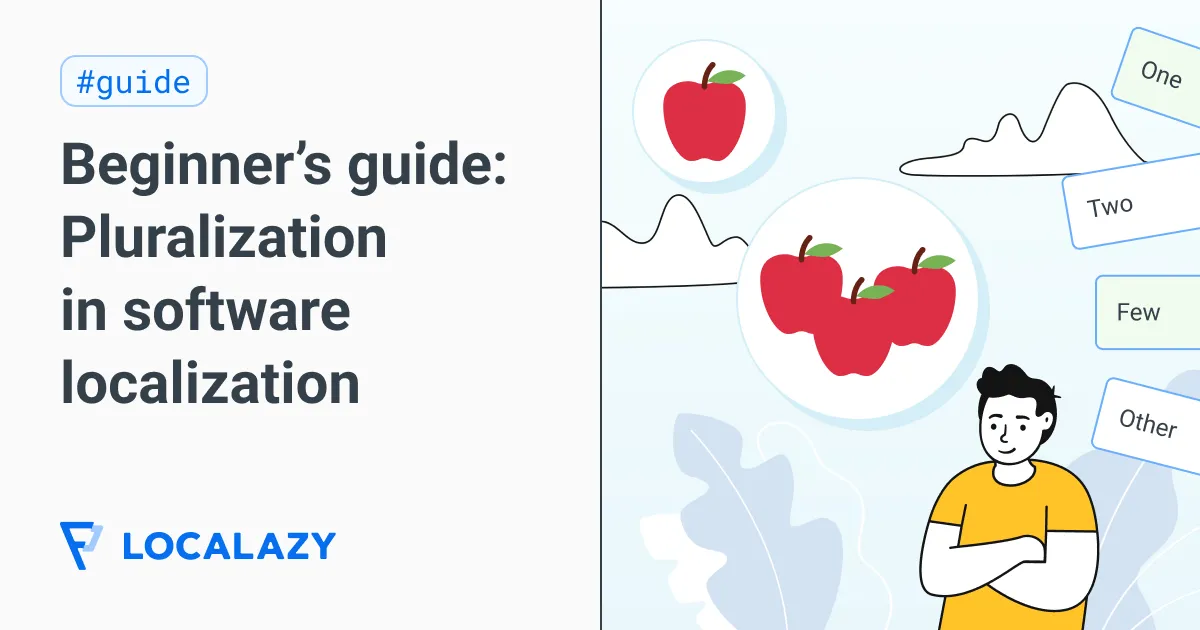
Languages have different rules for handling quantities. While English has just two forms (one apple, two apples), other languages can have up to six different forms. Localazy handles these rules automatically, so you don't have to.

The translation interface adapts to show only the relevant categories for each language. Translators see precisely the correct plural form fields for each language they're working on, so there is no confusion about which plural form to use.

Standardized, but customizable when you need it! ⚙️

Standardized, but customizable when you need it! ⚙️

Our plural form handling follows the Unicode CLDR standard, supporting the correct plural rules for all world languages.

Do you need to customize plural rules for specific languages to match your i18n library? You can also define custom plural forms per language, ensuring perfect compatibility with your implementation. 

Frequently Asked Questions

Plural forms vary significantly across languages, going far beyond the simple singular/plural distinction in English.

Languages like Arabic have six different plural forms based on quantity (zero, one, two, few, many, other), while some Asian languages like Japanese or Chinese don’t pluralize nouns at all. Other languages like Russian or Polish use different forms based on the last digit of the number.

These differences matter tremendously for localization because using incorrect plural forms makes your software feel unprofessional or even confusing to users.

When a Polish user sees “5 wiadomość” instead of “5 wiadomości,” it’s immediately apparent that the software wasn’t properly localized. Proper plural handling is one of those subtle details that separates professionally localized software from amateur attempts.

Localazy follows the CLDR standard of pluralization rules, and provides you with an interface to correctly provide all plural forms needed for the target language.

Learn more about the plural rules in the documentation

Last updated: 17/03/2025

The system automatically checks that all required plural forms have been provided for each language and ensures that variables and placeholders are consistently used across all plural variants—preventing runtime crashes due to missing placeholders.

For example, if a translator completes the “one” form but forgets the “other” form for a language, Localazy will flag this as incomplete.

This proactive validation approach means your applications will display correct plural forms across all languages.

Learn more about plural checks in Localazy

Last updated: 17/03/2025

Yes, Localazy’s Professional tier and above gives you access to custom plural rules per language.

While Localazy follows CLDR standards by default (which works with most i18n libraries), some frameworks or custom implementations might require specific plural handling. Through the Developer Console, you can modify which plural categories should be available for each language in your project.

This customization ensures perfect compatibility with any i18n framework you’re using. You can enable or disable specific plural categories (zero, one, two, few, many, other) for each language, ensuring that Localazy exports exactly the plural structure your application expects.

Last updated: 17/03/2025

While it might seem straightforward to code singular and plural forms with a simple if/else statement in English, this approach quickly falls apart when dealing with other languages. Different languages have drastically different rules for plurals - English only differentiates between one and many, but languages like Czech and Polish require different forms for 1, 2-4, and 5+ items, while Arabic has six different plural forms depending on the count.

Even seemingly simple cases get complex quickly. Russian changes forms based on the last digit of the number, except when the second-to-last digit is 1. These complexities mean that hardcoding plural logic creates a maintenance nightmare with nested conditions that break easily when adding new languages.

Building and maintaining these linguistic rules yourself essentially requires becoming an expert in dozens of language grammars rather than focusing on your core product. When expanding to new markets, you’d need to rewrite parts of your app for each language’s plural system, potentially delaying your international launches. Using a proper localization system that handles these rules automatically is both faster and more reliable.

Last updated: 17/03/2025
🏁 Ready to try Plurals in your project?

Start your 14-day trial now to see Localazy in action! 👀

Sign up now

Breaking language barriers

Read more

We enjoy combining our in-house people, automated professional translations, and crowdsourcing the translations...

Case Study company logo
Photo of the Case Study author
Lukáš Tóth
Product Manager at Rouvy
Read more

The ease of use is splendid. Localazy's UI is simple, clean, and intuitive, and the price/performance ratio is unbeatable.

Case Study company logo
Photo of the Case Study author
Martin Uher
CTO at Investown.cz
Read more

The UI is super easy to use, the toolset is awesome, and the integration into Laravel works like a charm!

Case Study company logo
Photo of the Case Study author
David Jardin
Founder of djumla
Convinced? Let's get started!

🚀 Try Plurals with your actual content. 🗒️

Try it now