I always have to take a deep breath when a translator writes in, not about a sensitive translation decision, but asking about an ambiguity. Another translator mentions that they found a typo. Another deep breath. And then the QA reviewers flag a contextual mismatch across seven languages. At least it wasn’t the client coming back after noticing an obvious error! 😅
If you have spent any time managing localization at scale, you will recognize this scenario. The problem was never the translation or the translator, but the lack of context. A lack of clarity and context upstream can quickly travel downstream into every single target language before anyone catches it.
This is the hidden cost of reactive localization. We spend enormous amounts of time and money fixing issues that could have been prevented before the first translator opened the file. And somewhere in the middle of that firefighting, the nuance can get lost too: the carefully crafted tone, the cultural sensitivity, and the UX copy that was supposed to feel native to its market.
Fixing errors across languages, cleaning up translation memories, and fielding a steady stream of questions from linguists takes time. I believe there's a better way of handling it
I've spent the better part of fifteen years in localization, much of it in transcreation for digital health and mental health content, where the stakes around source quality are unusually high. In that context, pre-translation prep wasn't optional.
A poorly worded clinical instruction, a cultural reference that is wrong for one market, a psychological intervention that is not effective for a certain culture... Any of these could mean the difference between content that actually works for a user and content that alienates them (or, worse, is simply incorrect). What I've learned in that space applies directly to SaaS, marketing, UX, and any content type where quality matters more than speed or volume.
The core lesson is this: you need to clarify and fix the source before translation begins.
How can we effectively do this? My proposal is this: a chat-bot style interface that parses a file and generates a thorough translator brief, requiring input and approval by a TM, and a way to integrate those instructions, segment by segment, into the TMS for easy, highly visible clarity.

🎯 Context is the hardest thing to communicate 🔗
Now let me explain myself properly. Pre-translation, in a traditional sense, is what your TMS does. It fills segments from the translation memory, flags matches, and runs an AI translation on the rest.
That's not what I'm talking about here. I'm talking about a step that happens before any of that: truly analyzing the source file. Because the traditional pain points in localization project management are predictable once you've seen them a few times:
- Translators ask the same clarifying questions across multiple languages.
- Cultural nuances aren’t clear (eg. "How much liberty do we have for this section?").
- Source errors, typos, and formatting inconsistencies can easily propagate into every target language.
- Character counts get exceeded because no one flagged the strings that were already pushing the limit.
- AI produces a low-quality first pass, precisely because it doesn’t understand the context fully.
These seem like translation failures at first, but they're preparation failures. And the standard response (fixing them in post-editing or QA) means you're fixing the same problem ten or fifteen times instead of once. We won’t even mention the dreaded possibility that the fix happens only after a client reports it!
This is a structural problem: the prep work that should happen before files hit the TMS often happens manually, inconsistently, or not at all. And even when it does happen, it's usually in a brief and disconnected from the tools translators are actually working in.
🤖 How AI has changed my pre-translation workflow 🔗
I held off on integrating AI into prep work longer than I should have, partly out of skepticism that a model could catch useful things. What changed my mind was that the LLMs were able to flag issues I would have missed and they did so pretty quickly. I'll show you two examples.
Finding what to swap, soften, or rewrite 🔗
In mental health content, culturally generic source text can reduce trust in a product. Early in my career, I spent countless hours building manual lists of macro-level adaptation suggestions before content went out for translation: which cultural references needed swapping (a specific holiday tradition, a celebrity analogy, a recommended activity that simply doesn't translate to how people in a given country relate to wellness...), which idioms or metaphors would lose meaning or land strangely, and which sections needed complete rethinking for certain markets.
There were also micro-level changes, like measurement systems, currency, terminology choices, and inline links where the URL language could be adjusted, or, if not, at least flagged as English-only for translators. Even if a style guide gave the directive to change these areas, I always wanted to remind the translators one more time to ensure it was done correctly.
That list, when done well, took hours. Now I use Claude or ChatGPT to generate a first pass, which I then review and refine. I use a prompt explaining as much as I can about our audience and style, and ask the platform to point out all the possible ambiguities or cultural nuance. The quality of the brief it generates is genuinely good and the time savings are significant. Reviewing 10,000 words used to take up to 5 hours. With AI, it’s down to 30 minutes or less.
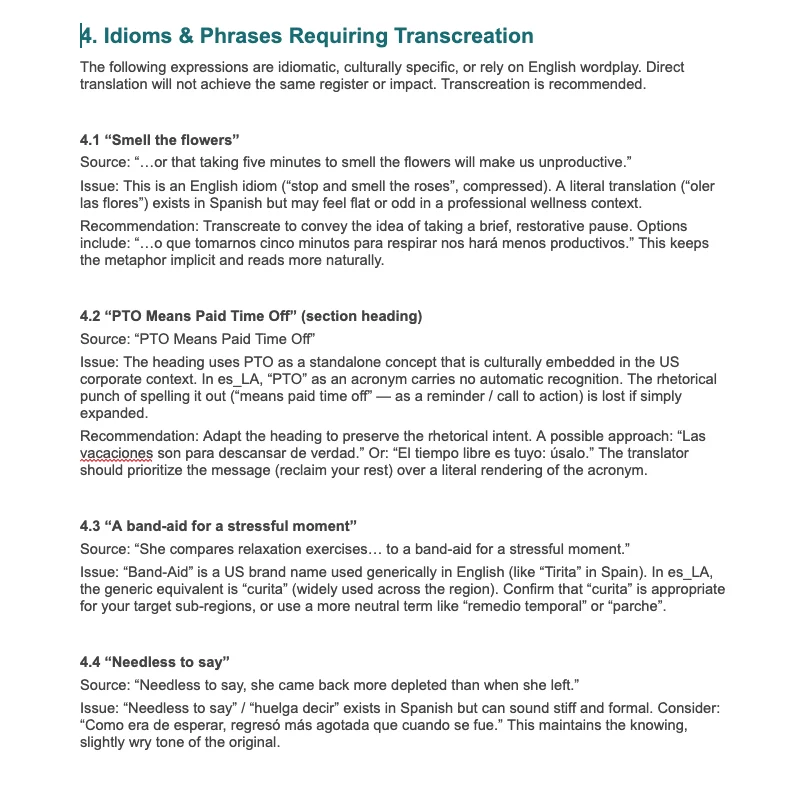
The example that stands out most in my experience is that psychological intervention activities in mental health content were often framed around culturally specific touchpoints designed to make users feel seen and spoken to in their own context. For example, an activity designed to help users improve connection and fight loneliness encouraged them to say hello to their bus driver or shop cashier. In Japan, the clinical advisor thought this would cause an added anxiety and recommended changing it to a small smile. A reference to enjoying some social time with their friends at a local hamburger joint wouldn’t encourage global users the same way, say, a ramen or taco stand might. Adapting those references directly affected both engagement and clinical validity.
Having AI surface those flags proactively, rather than pointing each one out manually, along with a suggested change (and possibly missing one, due to my own cultural background), changed the pace and quality of those projects considerably. Anyone who wants to intricately control the amount of transcreation done in a text can benefit here.
Mental health terminology is a related challenge. A term that functions as a clinical concept in English may require real expert vetting before it can be rendered in another language. AI won't replace that expert judgment, but it can flag where that judgment is needed.
📌 Related read: Why AI keeps repeating itself and what this means for local content
Anticipating translator questions 🔗
One of the most time-consuming parts of localization project management is answering translator questions that could have been anticipated. AI is remarkably good at predicting them.
Take the phrase "Dr. Brown’s research says [...]." In a string like that, without additional context, translators working in gendered languages immediately need to know: is Dr. Brown male or female? That question, multiplied across ten language teams, creates a chain of back-and-forth communication that delays delivery and fragments attention. Running the source through AI before it goes to translation produces a list of exactly these flags, ready to address before translators ever open the file.
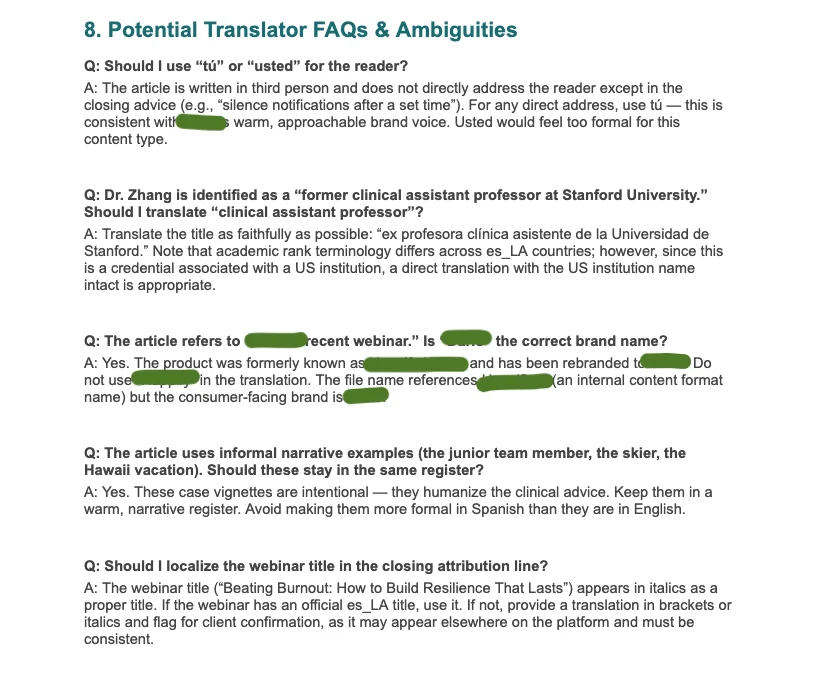
The categories AI tends to surface consistently are:
- Gender and pronoun ambiguities, especially relevant for languages with grammatical gender.
- Unclear references or antecedents ("it," "this," "the above").
- Format-dependent content: dates, measurement units, numerical formats...
- Brand names and proper nouns: transliterate or translate? Keep in source language?
- Acronyms and abbreviations: which need to be spelled out on first use, and what does the spelled-out version actually refer to?
- Tone: a gentle reminder about brand voice, tailored to this particular assignment, never hurts.
Beyond FAQ generation, AI also functions as a source proofreader in ways that spell-check alone doesn't cover. It tackles double spaces, inconsistent punctuation, formatting irregularities, grammar and style issues that aren't technically errors but can be fixed in the source file before they’re sent.
String length prediction is another application that pays off in UI localization. German and Russian expand significantly from English source text, and strings that are already pushing character limits will almost certainly break something downstream. Flagging those strings before translation starts, not in QA, means fewer rework cycles and fewer conversations about why the button text is now wrapping onto two lines.
Acronyms deserve a specific callout because they're a surprisingly common source of translator friction. Auto-flagging every acronym and generating a checklist, or better, running a chatbot-style dialog that requires the PM to confirm the spelled-out form before the file goes out, eliminates an entire category of translator questions and ensures the correct expansion is used consistently across all languages.
🪞Where this workflow still falls short 🔗
The pre-translation analysis process I've described above (asking Claude to analyze a file and produce a translator brief with all the points we’ve covered) works. It saves time, reduces back-and-forth, and improves source quality before translation begins. But in my experience, this brief, typically a list or document, still has to be communicated to translators separately from the TMS (email, project management tool, task description, etc.). That means a two-panel workflow at best: translators working in a CAT tool with an analysis document open in another window. At worst, it means that translators might miss the warnings entirely because checking each string to see if there are notes is time-consuming and tiresome.
This also produces a real risk in AI-assisted transcreation and the treatment of cultural references in particular. An LLM may produce a technically passable rendering of a reference that the client has actually approved for adaptation, but if the translator or reviewer doesn't realize they’ve been asked to pay special attention to that segment, the opportunity for real transcreation is lost.
A decent AI translation of a culturally specific phrase might be accepted, when the entire point of flagging it was to make sure a human considered whether something better was possible
An integrated alternative 🔗
What could this integrated analysis actually look like? Translator briefs are auto-generated and attached to each job, with the notes highlighted directly in the relevant segments of the CAT tool. Flagged segments that require transcreation are surfaced for mandatory review. A PM addresses ambiguities, confirms acronyms and approves adaptation decisions before any translation takes place. Micro-level changes like currency conversions and measurement system adjustments are included in the style guide and handled by AI but still flagged for human-in-the-loop review.
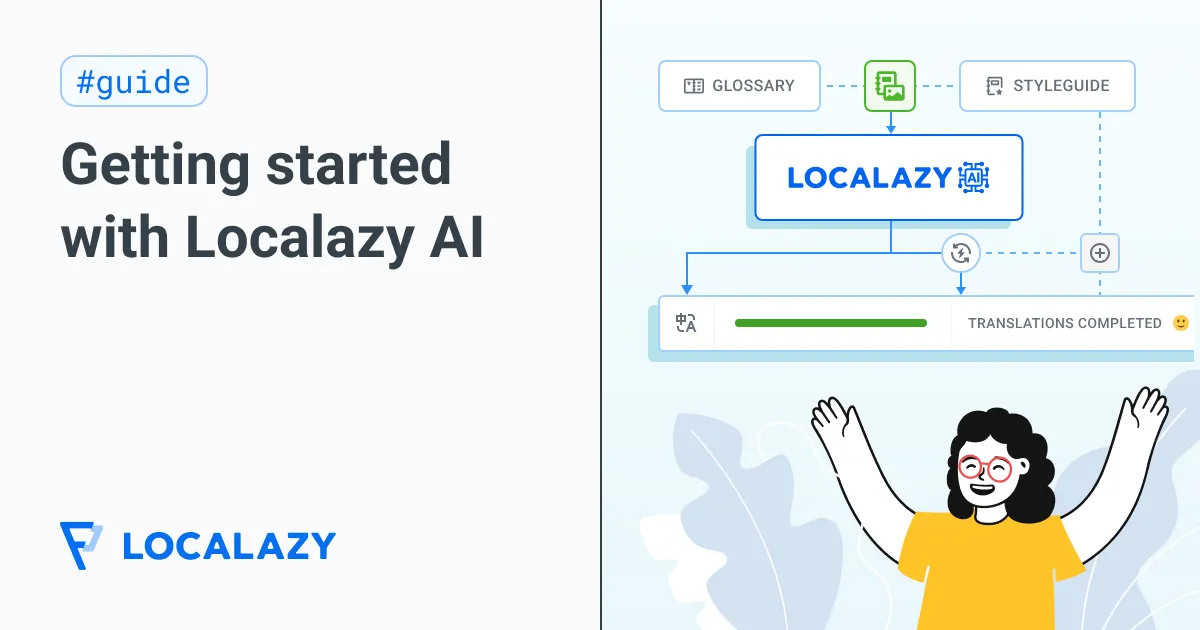
The style guide connection is already developing in some platforms: AI that knows your guidelines and applies them from the start. What’s ideal here, from a PM or ops perspective, or even as reassurance to a client, is the knowledge that these guidelines are being applied and brought to the attention of a linguist.
💰 The ROI math is straightforward 🔗
You may be thinking, wouldn’t this back and forth with ChatGPT or your LLM of choice result in more work for a PM before they can even assign a project? I’d say no. There's a straightforward way to think about the ROI for pre-translation analysis: time spent fixing an ambiguity, typo, formatting issue, or copy problem in the source language is always less than fixing it across every target language. As a PM, knowing that your preferences are easily visible to translators not only reduces their cognitive load but your own time spent checking back to see if they truly understood a segment or not.
What’s more is that the further downstream a source error travels, the more expensive it becomes. It's better to fix it once before translation starts instead of ten or fifteen times after QA flags it in each language, plus the source correction
Beyond the direct cost savings, there are real quality gains: fewer translator questions means translators spend their attention where it matters, on the segments that genuinely require expertise and judgment rather than on sourcing basic clarifications. They are given a better quality AI draft to work from and they know exactly what to focus on. And as a translator, what a boon! 😄Translator satisfaction is a non-trivial factor in localization quality over time. During my career, I've seen that the teams that invest in good source prep tend to develop better long-term relationships with their translators. An explanation of an idiom or an acronym reduces translators’ mental load and lets them focus where it counts.

Not only does quality improve but imagine an R&D team with fewer tickets on its to-do list. The elimination of QA issues and bugs to fix post-translation lightens the load of developers who can now spend their time improving the product in other ways.
And I just want to be clear. AI is not replacing translators or localization project managers in this workflow. Claude can suggest a pre-translation analysis but ultimately, a PM will want to ensure they agree with these suggestions. LLMs can do the preparatory work that used to fall entirely on human shoulders so that the humans in the loop can focus their expertise on decisions that actually require it and developers can focus on other pressing matters.
🗺️ Conclusion: Where do we go from here? 🔗
To get the most out of localization right now, you need to be doing the work upstream: before a file ever reaches your translation software. Pre-translation analysis is where AI earns its keep in this workflow by making sure human judgment gets spent on the segments that actually need it.
In part two, I put this into practice with a hands-on test of Localazy AI and its style guide tool, running through its pre-translation features to see where the integrated approach holds up and where the gaps still are.
I'd like to hear from other people working on this: which pre-translation AI applications are actually paying off in your workflows that I didn't mention here, and where is the friction still worst for you?