Germany remains the single largest digital market in Europe. In 2026, Bitkom expects revenue of over 112 billion euros in software and IT services alone. For companies in the SaaS, app, and e-commerce space, it is also one of the most demanding localization markets.
Germany is the 4th most English-proficient country in the world among non-native English speakers. Yet German localization is a must. This becomes painfully obvious especially with pricing pages: I almost always have to localize (really transcreate) rather than translate them, because they are full of stuff like tiered plan names and tax handling that gets confusing fast when it's not properly adapted.
Germans speak English when selling but buy in German. When they hold the wallet, they set the terms, not the least because German procurement is famously thorough. German corporate culture is simply more at ease making high-stakes decisions in its own language, especially in mid-size Mittelstand firms and especially when the outlook is a long-term relationship.
This guide walks SaaS, app, and e-commerce teams through every stage of expanding into Germany: what the market expects, where foreign launches fail most often, and how Localazy helps you build a product that German users trust.
🤝 What earns the trust of German customers? 🔗
As of 2026, Germany remains the largest economy in Europe. The country's GDP reached €4529.7 billion in 2025, up 0.2% from the previous year, with the digital sector outperforming the broader economy. Online retail reached €92.3 billion in 2025, a 3.9% increase over 2024. Forecasts for this year suggest a trajectory that will continue to go upwards.
Understanding this market means understanding its people. German buyers are risk-averse. They compare specifications, read reviews in detail, and expect precise (not persuasive) product descriptions.
The specifics depend on your segment. For a SaaS product, compatibility and reliability are primary decision criteria. Security, data compliance, and German-language support and UI are what get you on the shortlist. In D2C, there is no trust without a localized and transparent shopping experience, and if you don't want your brand to die a silent death, the return process needs to be frictionless. According to IPC data via Landmark Global, 85% of German shoppers won't buy without a clear, free return policy. Return rates vary; in fashion, over 50% of all orders are returned. Bracketing with the intention of sending most of the items back is standard behavior.
Risk aversion also explains Germany's preference for pay on invoice. In 2024, it was the preferred choice for almost 30% of German online transactions.
For 85% of Germans shopping online, a difficult return is enough to halt a purchase entirely
In a similar vein, data protection is your license to operate. Treating it as a trivial sideline misreads German history. Privacy is a deeply rooted defence mechanism against state and corporate overreach. Ignore this at your own economic peril.
Rooted in history as well: Germany is not one market. Regional differences are real and commercially relevant. So is the fact that 66% of German e-commerce happens on mobile, on a market where Android holds over 70% of the OS share (Q3 2025).
For success in the German market, invest wisely; localization is a strategic decision, not a marketing expense. If it feels as if you are just passing through, Germany won't trust you.

🏭 5 sectors where German localization has the most direct impact 🔗
In Germany's digital market, strict compliance requirements and cultural preference demand precise localization. Take these into account, as they have a direct impact on conversion, especially in these five industries:
SaaS and B2B software 🔗
Software sales are expected to reach €58.3 billion in 2026. 47% of software buyers prefer German support and 38% German UIs. Localization makes your product credible.
E-commerce 🔗
Language, payment method, return policy, and legal compliance directly influence the purchase decision, and consumers leave if your site doesn't feel local.
Fintech 🔗
Stringent rules like BaFin licensing, GDPR, and MiCAR demand German interfaces, local IBANs, and adapted KYC processes.
Beauty and home care 🔗
Strict legal mandates require German labeling and EU law compliance, and the market expects culturally attuned sustainability marketing. German consumers actively research ingredient origins and supply chain ethics before buying. Green branding is nothing without actual substance.
Digital health and DiGA 🔗
With 70% of the world market, Germany is the global leader in digital therapeutics. BfArM certification (required for prescription reimbursement for over 74 million statutory insurance holders) makes localization a legal prerequisite.
🗣️ 3 questions from foreign digital companies 🔗
Germans are skeptics. If you want to sell, you have to prove your competence. Make the wrong language decisions, and watch the trust scroll away to your competitor.
Should you use Sie or du in your German app? 🔗
Whether to use the formal Sie or the informal du depends on sector, age, context, price point, and product intimacy. Make the wrong choice, and your target audience assumes it isn't for them.
- 💅 Young and trendy? Use du.
- 👨🏻💼 Serious and full of risk? Sie it is. Traditional industries like legal, finance, and enterprise software default to Sie, especially in B2B.
- 🚿 Products that touch the body or personal space trend toward du because the relationship is intimate.
- 💎 The more expensive it gets, the more immovable the formal Sie becomes.
Whatever you choose, apply it consistently across all touchpoints. Don't risk being read as toying with Germany.
How much does German text expand compared to English? 🔗
An English text translated into German usually expands by 10% to 30%.
Precision, for one, is not only favored by German business culture but is also a fundamental aspect of the German language. Extra "grammatical glue" makes sure the relationship between words stays unambiguous. Cultural and stylistic preferences, along with the requirements of formal register, add further length.
And the infamously long compound nouns (Mark Twain once mocked them with relish) can get you in trouble infuriatingly fast. Adding a bunch of extra characters on top of the original design will break fixed-width buttons, truncate in a dropdown, and wrap in silly ways in a mobile UI. But see it for yourself:
| 🇬🇧 English UI string | 🇩🇪 German equivalent |
|---|---|
| Skip | Überspringen |
| Notification preferences | Benachrichtigungseinstellungen |
Do Austria and Switzerland use a different German than Germany? 🔗
Yes, and the difference goes well beyond everyday vocabulary. 🇦🇹 Austrian German and 🇨🇭Swiss German are distinct national standards, with different official terminology in legal, administrative, and medical contexts. Switzerland, furthermore, uses francs instead of Euro, and does not use the letter that confuses English speakers most: the ß.
DACH is not a single market with regional accents. It is three markets that share a language family. Treat them accordingly.
🎙️ Listen to Christina Hammer, CEO of Clanq, talk about localizing a fintech product into the Swiss-German market with the help of Localazy.
⚠️ 4 localization mistakes that make German users suspicious 🔗
Your German competitor has the home field advantage. Impressum, compliance, language that comes naturally... It's the default for them. Avoid the mistakes below, and don't hand them the ball.
Mistake 1: No Impressum 🔗
The Impressum is a legally mandatory page on every commercial website operating in Germany, required under the DDG (Digitale-Dienste-Gesetz). It must include the company’s full legal name, physical address, and contact details. Depending on the business type, you must also provide the VAT number, commercial register entry, and the name of the person responsible for editorial content.
Distance selling regulations under the BGB (§§ 312 ff.) add further disclosure requirements for e-commerce. German courts enforce these actively. Competitors can and do issue Abmahnungen (formal legal warnings) for non-compliance. In the worst case, the lack of an Impressum can cost up to €50,000.
Mistake 2: Ignoring accessibility requirements 🔗
The Barrierefreiheitsstärkungsgesetz (BFSG) is the German implementation of the European Accessibility Act (EAA). It requires websites, apps, e-commerce platforms, and digital services targeting German consumers to meet WCAG 2.1 Level AA accessibility standards. Fines for non-compliance reach €100.000. The law applies to any B2C company with 10+ employees and €2 million+ annual turnover selling into Germany. Although B2B websites do not formally fall under this law, they would be unwise to dismiss it. Large corporations (especially those with government contracts) increasingly require their suppliers' digital products to be accessible in order to keep their own supply chains compliant.
Mistake 3: GDPR and cookie consent treated like a checkbox 🔗
Germany, like the rest of the EU, maintains a high standard for cookie consent. Under the TDDDG, it is not only important if you ask for permission, but how you ask. Furthermore, a clear opt-in is mandatory, which has effectively killed "Legitimate Interest". Violations are handled with zero tolerance, resulting in fines that can reach €300,000.
GDPR (DSGVO) compliance requirements apply on top. What may surprise you: they also limit the transfer of data to third countries like the USA. Violating privacy laws will not only rack up fines, but also make you look untrustworthy and deter buyers.
Mistake 4: Choosing the wrong translation workflow 🔗
Depending on where you use your words, they do different jobs: they describe, explain, persuade, evoke emotion, connect, take care of regulations and compliance, guide your user through your product. Some are written by copywriters, others by UX writers or lawyers. Your approach to localization has to respect this; otherwise you risk losing engagement, compliance, or product functionality.
In my experience, mistaking localization for a paint-by-numbers task is fairly common, and, just as often, it isn't recognized as a mistake at all. I assume this is one of the downsides of the "black box effect" of the whole translation process. The process is not understood but deals with words — something we all use daily ourselves. Consequently, we assume that something so familiar can't require real skill, that it’s just a matter of swapping words. In reality, it is a process that can be guided and shaped to individual needs as long as it is treated like any other discipline that requires real expertise. Setting up processes and choosing tools without that expertise often leads to subpar results: copy that can't keep visitors on the page, and marketing that doesn't convert.
The process of localization is not a paint-by-numbers task: it can be shaped to individual needs as long as it's lead by real expertise and efficient tools
Localazy lets you mix and match localization strategies to give every text what it needs, whether it's adaptive marketing translation done by humans, MTPE or continuous localization. Without this flexibility, a landing page that does not engage, privacy that's disrespected, or a UX with overflowing button text tells a story that makes a German audience disengage immediately: one of incompetence and ignorance.
🎯 5 ways to actually reach the German customer 🔗
Tip 1: Lead with proof, not enthusiasm 🔗
Even if the big benefit makes everyone cheer in your country, in Germany that's mainly noise. Instead of a "Benefit-Feature-CTA" flow, Germans expect you to address the problem first and explain the mechanism. Without a sound foundation, your features aren't even noteworthy. Ditch the hype. "The best product ever" will only get you ignored. However, with "40% fewer errors — here's how" you'll gain trust. Strengthen that trust further by following through with your decision for either Sie or du across every touch point. If your UI uses du but your emails switch to Sie, you’re signaling chaos, undermining your credibility.
Tip 2: Compliance makes you trustworthy 🔗
Content and placement of Impressum, GDPR notice, and cookie consent banner are subject to rigid legal rules. Following those rules adds a layer of credibility. Even if German buyers do not read the whole of your Impressum, they'll check that it exists, that it shows a real name and address, and that it looks like a serious business. A missing Impressum, a GDPR notice that reads like a machine translation, or a cookie banner that lets you jump through hoops before you can reject cookies, however, all send the same signal: nobody accountable is home. The internet has become a playground for scammers, grifters, and wannabes. Still, in essence, Germans want to trust you. Comply and send them the message they need.
A missing Impressum or machine-translated compliance copy sends one signal to a German buyer: nobody accountable is home
Tip 3: Offer more than just credit card payment 🔗
In Germany, the cultural skepticism toward credit runs deep and credit-card-only is inviting cart abandonment. German D2C buyers favor trusted, account-linked methods, with PayPal and payment on invoice (Rechnungskauf) leading based on recent surveys from the EHI Retail Institute. For recurring billing in SaaS, SEPA direct debit is widely viewed as the standard due to its strong consumer familiarity, and PayPal is essential for lower-value SaaS transactions targeting SMBs or freelancers. In the younger "digital-native" segment, Klarna is still small but growing via BNPL and flexible payments.
Tip 4: Don't let German text break your UI 🔗
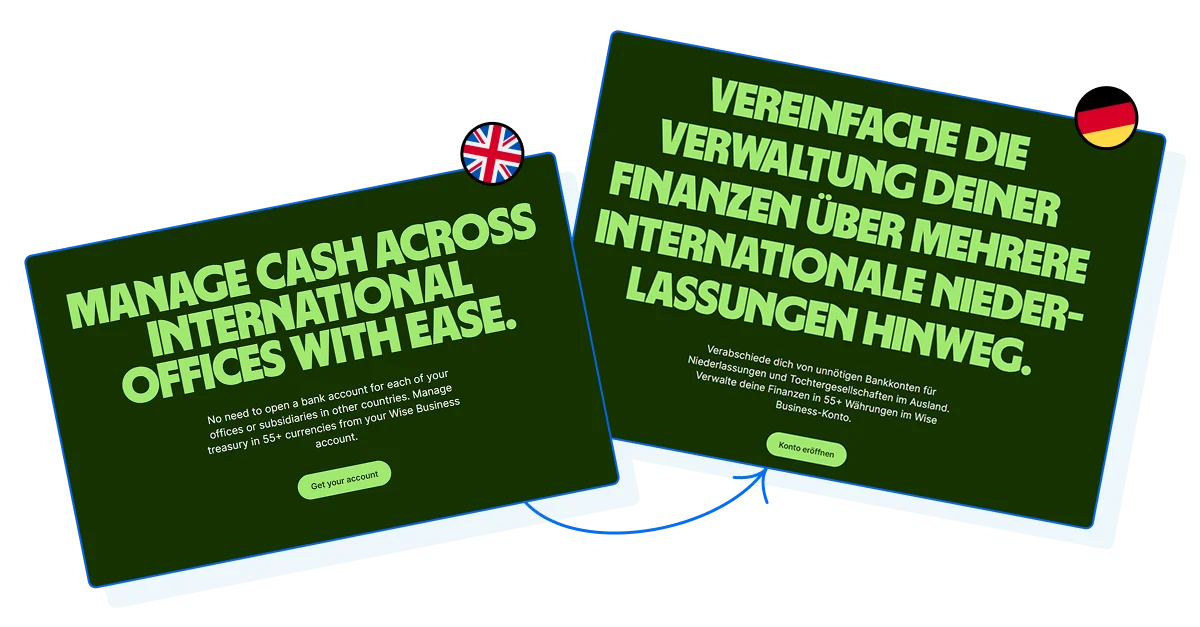
You already know that German text expands. It also cannot be split as easily. "Privacy settings" and "Payment overview" in two rows? No problem. "Datenschutzeinstellungen" and "Zahlungsübersicht", however, need language expertise to break across lines correctly.
Localazy makes it easy to adapt your UI to German text length. No post-translation patchwork: it flags translations over set character limits. Plus, you can deal with placeholders and pluralization, and test in-context design with their Figma integration before errors reach your users.
Tip 5: NRW is not Bavaria: — respect regional differences 🔗
Germany has no single dominant hub like London or Paris. It has 84 million people across 16 federal states with significant social, cultural, and economic variations.
But while these 84 million are distributed across 16 to 20 major dialect groups and dozens of modern regiolects and metrolects (all of them alive and kicking) business communication and marketing rely solely on Standard High German ("Hochdeutsch"). Rule of thumb: Only ever use dialect in your commercials if your name is Seitenbacher and you are selling muesli. 😄
In addition, to successfully sell software here, you must navigate different regional tech ecosystems:
- 🧑💻 Berlin is the testing ground for B2C apps and early-stage SaaS. It is the most international city in Germany, with the highest concentration of early adopters. The vibe is future-forward and very casual. Be punchy. Be optimistic. Definitely don’t shy away from modern tech jargon. In Berlin, be ambitious and invite people to join your tech revolution.
- 💼 Munich is where B2B SaaS, "Mittelstand" targeting, and industrial tech belong. Here you find the large industrial and financial buyers like BMW, Allianz, and Siemens. Here, you stick with the formal Sie until explicitly invited to do otherwise. The register is rigidly formal. Be analytical. Be academic. No hype. Know your figures and your benchmarks. Formal whitepapers and heavily detailed PDFs are your friends.
- 🌱 Hamburg is the strongest growth market for logistics, supply chain, GreenTech, and maritime tech. Hanseatic understatement is a way of life. Don’t brag. Don’t overpromise. Don’t flash wealth. It only gets you ignored. Instead, be calm, factual, data-driven, and pragmatic. Being direct is okay, but stay respectful. While you will start with Sie, the transition to a professional du happens much faster than in Munich.
For e-commerce and logistics, the population density of NRW's "Metropolregion Rhein-Ruhr" makes it the most efficient testing ground for last-mile delivery and fulfilment operations. This region is my home, and I can tell you that we are famously direct, blunt even. Our local culture is deeply influenced by our industrial, working-class history. There is zero room for fluff here. You'd best pragmatically roll up your sleeves, stay honest and no-nonsense, and solve problems — fast.
💡 3 German market lessons of right and wrong 🔗
First, observe, analyze, and adapt. Assuming you know the play on an unknown field can be very costly.
IKEA: Practicality prevails 🔗
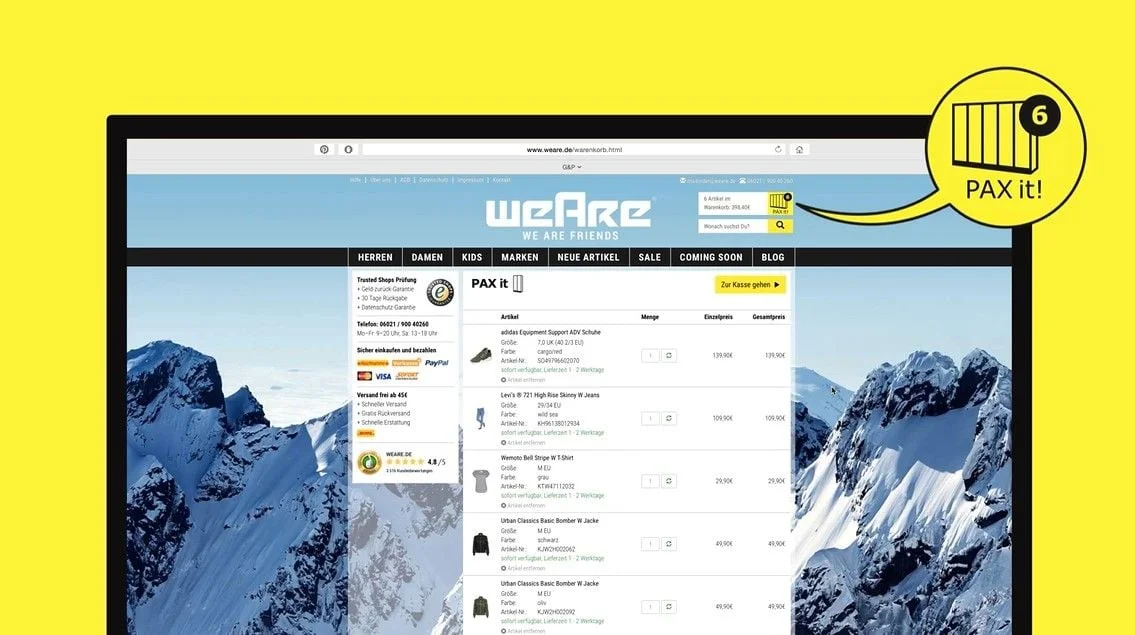
IKEA recognized something most foreign furniture brands missed: German homes lack built-in closets and German consumers prefer practicality over fixed designs. Instead of selling traditional Swedish shelving, IKEA positioned the PAX wardrobe system as a modular freestanding solution, customizable and space-efficient. PAX became IKEA Germany's bestseller, with high demand causing stock shortages, prompting IKEA to optimize production and design.
The PAX wardrobe succeeded in Germany because IKEA understood something competitors had stopped seeing: customers preferred flexibility
Netflix: Regional preferences first 🔗
And then there's Netflix. German media consumers prefer dubbing over subtitles for foreign content, a tradition rooted in early TV practices. Netflix adapted. Instead of forcing subtitles on a market that treats "OmU" (Original with subtitles) as a niche preference, they dubbed 60% of foreign content across their four largest EU markets, including Germany. In 2017, they went further, commissioning Dark (their first non-English original series) with a German cast and crew specifically to sound native to their audience.
Walmart: Copy-paste doesn't work 🔗
Walmart’s "excursion" to Germany from 1998 to 2006, on the other hand, was a billion-dollar masterclass in cultural arrogance. They treated the German market like a carbon copy of the U.S., ignoring German competition law prohibiting below-cost pricing. The "Walmart way" alienated staff and shoppers alike; store greeters felt intrusive, and the attempt to ban workplace relationships clashed with German labor law. By failing to adapt, Walmart proved that even a giant can fall if it doesn't read the room.
✍️ Your German localization checklist 🔗
In Germany, the best way to avoid administrative purgatory and masterclasses in failure is thorough preparation. You can start with a few to-dos:
- ☑ Choose your register. Pick Sie or du and stick to it across every bit of text. Inconsistency raises suspicion and signals a devil-may-care attitude.
- ☑ Lead with proof instead of enthusiasm. Structure documentation and relevant processes to explain the mechanism before the benefit. In Germany, facts and figures do the selling.
- ☑ Make compliance credible. German buyers are cautious and need trust signals. Impressum, GDPR, and cookie consent help eliminate suspicion and shield against cart abandonment.
- ☑ Offer the right payment methods. Germans favor purchase on account, PayPal, and SEPA direct debit. Credit-card-only checkouts are basically an invitation to leave.
- ☑ Pick your city or region wisely. Match it to your product or service for an easier entry. Germany is not one market but an economic rag rug.
Localazy is built exactly for the challenges this guide covers: from handling German text expansion and pluralization rules to managing DACH locale variants and keeping your translation workflow continuous. If you are preparing a German market launch, book a demo, start your 14-day trial, or get in touch.