Since we launched Localazy AI one year ago, our team has made strides in improving its speed, capabilities, and underlying prompt quality. The goal is to make your translations sound as natural and accurate as ever, following all the instructions to ensure cultural correctness and audience alignment.
Today we released what's probably the biggest update of our AI so far. Here are the details.
🚀 A faster, smarter underlying model 🔗
Localazy AI is built on a multi-agent setup that collects context, processes it, translates the texts and runs post-translation verification. It's not a simple prompt but a complex system of processes involving AI.
Today we upgraded the underlying model to GPT 6 Sol, one of the top frontier models in the market.
In terms of performance, this will mean that you'll get:
- Faster processing of your strings (30%+ time reduction).
- Higher quality translations (our internal tests show 70% fewer errors in our crafted testing translations).
👉 Check out this post from our AI Lead, David Václavek, to learn how we've built our QA setup
What makes our AI different 🔗
Localazy AI is not a prompt. It's what is usually called an AI harness, similar to a platform like Claude Code. It utilizes an agentic loop that allows the agents to call external tools for collecting context, processing it, asking for project and audience preferences, retrieving glossaries, and performing several steps to prepare, translate and adapt your texts.
It also comes with our own skills that enhance the prompt, including instructions to process elements like ICU Messages, plurals, or specific cultural nuances.
You can expect highly accurate, contextually-appropriate results when using it.
Why are there still some errors in our internal tests? 🔗
Translations are tricky, and our internal tests are designed to be hard even for human translators. AI is a great tool, but reliability is not 100% yet. That's why it's still wise to include humans in the process.
With every release, we strive to get even better and autonomously translate more test cases correctly.
🔢 Improved support for ICU, plurals and HTML 🔗
ICU Message Format is a type of localization-friendly syntax that allows developers to write plurals, genders, and many other dynamic messages in a simplified manner.
It can get a bit complex, with nested rules that look like this:
{gender, select, female {{count, plural, one {She has # friend} other {She has # friends}}} male {{count, plural, one {He has # friend} other {He has # friends}}} other {{count, plural, one {They have # friend} other {They have # friends}}}}Our latest improvements ensure better contextual awareness, as well as support for different plural rules and edge-case formats. With Localazy AI, texts are not translated word by word: plural forms vary depending on the target language and control characters must keep the correct configuration. We use similar solutions for other formats, like HTML tags.
🔎 Better contextual clues 🔗
Based on our testing, GPT 6 Sol is better at preserving and following the contextual rules and instructions that is given, leading to better translations.
We evaluated many different models and options with our set of tests, and GPT 6 Sol performed the best.
💬 Prompt improvements 🔗
We keep improving our prompts and skills, and even small details can vastly affect the resulting translations. It's not always just about the quality of the translation itself, but about the validity of the output. This last round has strengthened this, so it's likely you'll notice a difference for the better.
📩 Your feedback matters 🔗
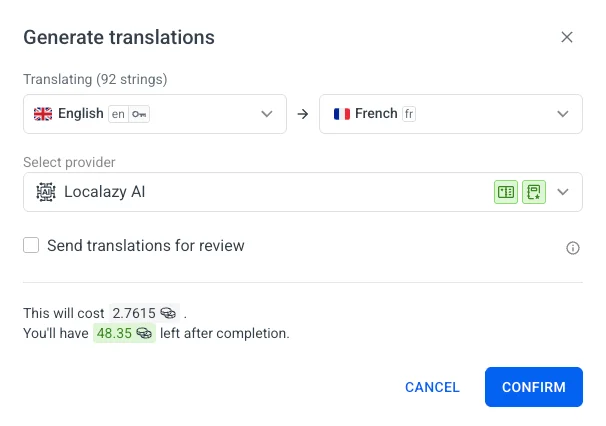
If you're using Localazy AI or contemplating on trying it, give it a go today! Just log in to your account, batch-translate some strings using it, and tell us what you think of the result. For optimal results, we recommend setting up a style guide for your project. It's just a few clicks that make a real difference in the final output.
We can't wait to hear your opinion to make this the perfect model for your needs.
Contact us with any suggestions here.