There’s no magic spell that will make your brand instantly visible on the global market.
But there’s localization. There’s multilingual marketing. And now, there’s GEO, too.
🥣 A powerful new ingredient that has been recently thrown into this mix.
What is it exactly, and why does it matter for your business?
🔎 The visibility trick 🔗
Ask that question to an AI search model and you'll find your answer. Possibly, a different one depending on the platform. What’s the best in the eyes of ChatGPT might be overlooked in the results coming from Perplexity, and what Gemini considers no. 1 might display towards the end of the output in Claude. Or not mentioned at all.
The latter is not an option for any future-oriented and visibility-focused brand. But how can you make sure your business gets a prominent feature in the responses generated by AI?
Is traditional SEO enough? Or are there other tricks you need to learn to create an effective global content strategy for AI search?
If I were an LLM, I’d give you a confident answer. Probably biased and superficial. But since I’m an honest human, here’s my take: it’s not that simple.
It’s not only about SEO.
It’s about presence, trust, relevance, and, increasingly, language diversity as well. And that’s exactly where Generative Engine Optimization (GEO) comes in.

👩💻 From SEO to GEO: A shift you can’t ignore 🔗
By 2028, Gartner forecasts that brands’ organic search traffic will drop by 50% as users shift to generative AI‑powered search. In the good old Google days, mastering keywords, backlinks, and bounce rates was your ticket to climbing the search rankings.
But in the era of generative search, that strategy alone won’t cut it anymore. You need to be where your potential clients are. And that means showing up in conversations powered by AI. Since LLMs entered the scene, users spend more of their time chatting, ideating, researching, and discovering brands through generative platforms. 💬 If your brand isn’t present there, it’s falling behind.
GEO helps ensure your brand is visible in AI search platforms such as Claude, Gemini, ChatGPT, or Perplexity. These models don’t serve a set of blue links. They generate synthesized responses from training data, public sources, citations, and recent web content.
“LLMs are becoming a go-to source for information,” says Irina Maltseva, SEO Advisor, Growth Lead at Aura, and Founder at ONSAAS. “People aren’t just searching on Google anymore. As adoption grows, brands that start optimizing for generative search now will stay ahead. GEO also plays a big role in multilingual markets, where local context matters more than ever”
This includes optimizing for natural language queries, semantic relevance, and AI-friendly formatting. But visibility is just one part of the challenge. Measuring visibility is equally complex.
“Google Search Console doesn’t show AI Overviews data, and LLMs don’t share analytics,” Irina adds. “Still, tools like Profound, Scrunch, and Athena offer directional insights, even if they rely on simulated prompts.”.
One useful metric used by these tools is Share of Voice (SOV), which tells you how much "voice" or presence your brand has in digital search. It measures how often AI models mention your brand compared to your competitors across platforms, topics, and languages. Tracking your SOV isn't just another vanity metric. It’s essential to stay relevant and visible.

This shift from SEO to GEO matters for several reasons:
- 🤳 Generative search is often zero-click: Users don’t browse, they act on what the AI says.
- 🗣️ Multilingual prompts are on the rise, especially via voice or mobile queries.
- 🗺️ AI platforms aren’t limited to English, even if that’s your default content language.
- 🏃♀️➡️ Early movers win: Optimizing for AI now helps you dominate emerging search patterns before competitors catch on.
“For B2B research, users will increasingly delegate the task of creating shortlists and comparing solutions to AI,” says Jan Onesork, Senior SEO Consultant at Onesork.com. “It acts as a powerful filter, and what doesn't get through this filter is unlikely to ever reach a human decision-maker. Caring about your visibility within this new paradigm isn't just an SEO tactic. It's a strategic necessity for survival and growth”.
All of this means you need to educate AI models on your brand’s value. This will keep your product on the radar for consumers relying on generative answers.
🌍 Multiplied impact with multilingual content 🔗
GEO is still evolving, and many of its inner mechanics remain a mystery. We don’t yet know exactly how each model evaluates content before surfacing a brand in its responses. And with every model update, your AI visibility can shift. Still, SEO and GEO experts agree on a few best practices that can increase both your market share and share of voice in generative search.
Here are some useful strategies:
- 🛜 Structure your website so it's friendly for LLMs.
- ✍️ Make sure you use simple, readable, natural-sounding language.
- ✔️ Maintain strong rankings in traditional Google search.
- 🤖 Be present on platforms that have official content partnerships with AI models, for example, ChatGPT references licensed data from Reddit, News Corp, and Vox Media.
- ☝️ Focus on content richness, authority, and relevance.
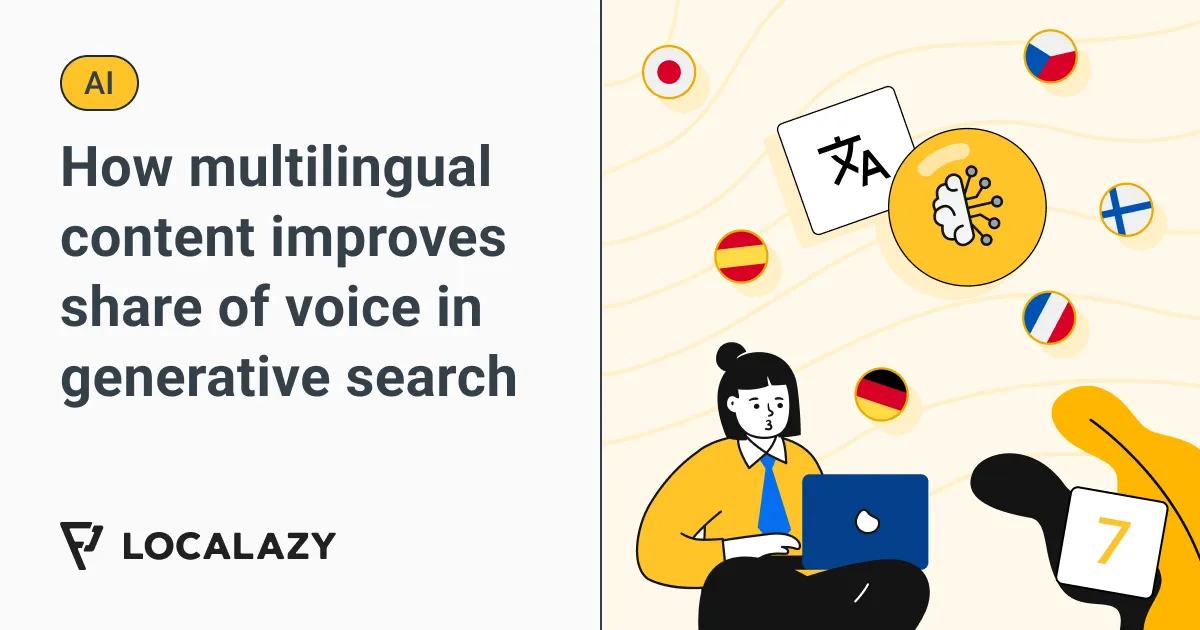
The last point is exactly where multilingual content can help. When you localize your website into languages like Greek or Finnish, you're not just expanding your audience, but also filling critical gaps in language coverage. Many AI models are primarily trained on English content. So, when they search for sources in underrepresented languages, there’s far less to choose from. That’s your opportunity to shine. Your product guide or blog post might be one of the few credible resources available in that language. And in low-competition spaces, that often means your brand gets featured first.
As many AI models are primarily trained on English content, publishing credible multilingual resources increases opportunities for your brand to be featured on generative search
But text is only one piece of the puzzle.
🔈 Multilingual voice search is equally essential. Whether someone’s asking Siri in Italian for “the best remote onboarding tools” or prompting ChatGPT in Polish about GDPR-compliant CRMs, these queries tend to be longer, more specific, and rich with intent.

When people speak, they naturally use full sentences, add context, and reveal what they’re really looking for. Not just in English, but across dozens of languages. These voice queries are conversational, nuanced, and still largely under-optimized.
That’s what generative models are hungry for.
By tailoring your content to mirror how people speak, especially in mid- or low-resource languages like Japanese, Czech, or Hungarian, you reduce competition and increase your chances of being featured in AI-generated answers.
Because these spoken queries carry more context, LLMs can interpret them more accurately and present more relevant results. And since fewer websites are targeting these exact long-tail, natural-language phrases, optimized localized content has a much clearer path to visibility.
📖 Recommended read: Why are LLMs so verbose? Tips to fix half-cooked results
📈 Hands-on tactics to improve your multilingual AI visibility 🔗
It all sounds promising, but what exactly should you do to build AI visibility? Where to begin this journey to ensure your brand appears in the results across platforms and in multiple languages?
Here are some practical tips based on our conversations with some experts:
1. Map conversations, not just keywords 🔗
While keywords localized per language and country might help boost your visibility, the biggest change happens when you optimize your content for conversations.
“The most effective starting point is to re-map your user journeys with AI as a key touchpoint”, says Onesork. “Use frameworks like 'Jobs-to-be-Done' to identify the specific problems your customers are trying to solve and then list the questions they would ask an AI assistant at each stage”.
But this journey might shift slightly depending on the language, culture, and local context. What a user types into an AI search model in Spain might be phrased completely differently in Japan, even if they’re looking for the same solution. To show up in generative answers, your content needs to reflect how people ask questions and express needs naturally in each market.
2. Earn great mentions (and links) 🔗
Backlinks still matter, but in the world of AI-driven search engine optimization, brand mentions are becoming equally critical. AI assistants often cite sources they recognize and trust, and that trust comes from repeated exposure across reputable platforms.
“Your success is highly dependent on proper brand building, PR, and distribution,” says Michal Pecánek, SaaS SEO Consultant at Michalpecanek.com. “That’s always been in the SEO win formula, but the ‘good enough’ threshold moved up with AI adoption. Good enough SEO without proper backup from other marketing channels doesn’t cut it anymore”
To improve your discoverability in AI results, aim for mentions in industry media, trusted directories, and niche communities where your audience spends time. The sentiment and authority of these sources matter, too. The more your brand shows up in credible, relevant contexts, the more likely AI is to include you in the conversation.
3. Write AI-readable content in each language 🔗
Generative models won’t feature your content if they can’t grasp it. Or quote it. AI engines don’t just scan for keywords: they look for structured, scannable content that can be extracted, summarized, or directly reused in answers. 📋
That means you’ll need to delete those dense, complex paragraphs in favor of clarity. Use Q&A formats, bullet lists, plain language, and short answer blocks. These structures help AI identify what your content is about and when it’s relevant.
But don’t just do this in one language. Go the extra mile and focus on GEO localization. A Polish how-to page or an Italian FAQ deserves the same semantic clarity as your English version. The more readable your content is, the higher the chances it will be captured and quoted by LLMs and shown to the right users in the right language.
The more readable your content is, the higher the chances it will be captured and quoted by LLMs. This includes content localized to other languages
In all these endeavors, remember that the quality of your multilingual content marketing still matters. This means publishing pages or blog posts written by humans, not machines. That’s the kind of content both search engines and AI models are more likely to trust.
Generative AI won’t create superior SEO- and GEO-optimized pages for you. It will only recycle old content and serve you a different version of what already exists.
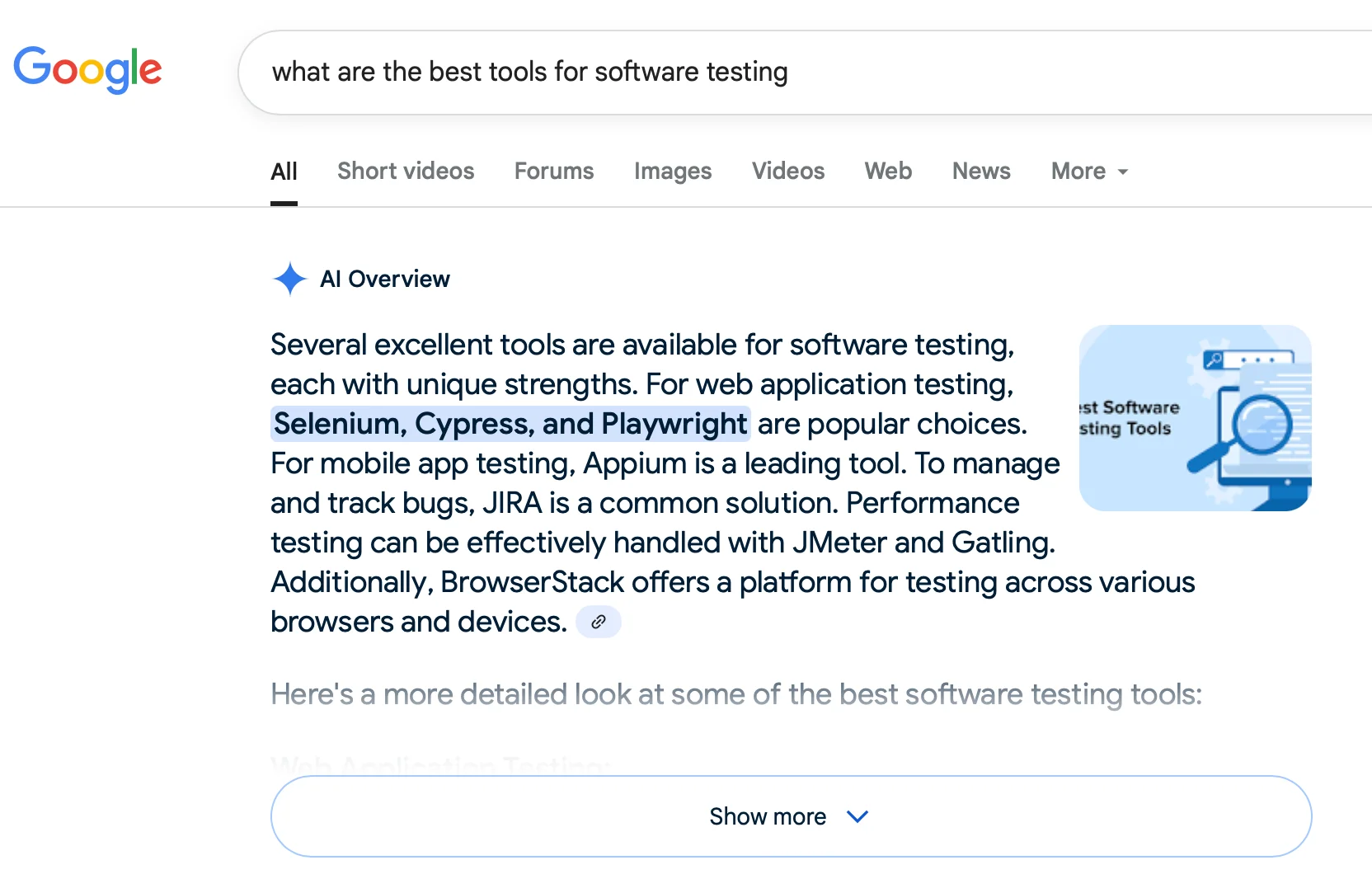
There’s one more reason why localized content can boost your visibility: Google has recently integrated its automated, AI-powered translation into its search engine. Not a bad move by itself, but here’s where it gets tricky: if AI Overviews can’t detect content in the user’s native language, Google automatically translates the text from English. And keeps the local traffic to itself. This means that original content creators won’t see those valuable clicks and views as the results are displayed on Google’s subdomain. Without localized content, you’re very likely to lose control and visibility over your international traffic.
4. Win in the invisible long-tail keyword market 🔗
“Strong organic rankings still influence LLM visibility”, says Maltseva. “A study from ZipTie found that ranking #1 in Google gets you cited in AI Overviews 25% of the time”.
Organic rankings matter especially for long-tail queries. While AI platforms don’t copy search results directly, they often use SERPs as a trust signal when deciding which sources to reference.
“We’re now able to get hyperpersonalized AI output, so our prompts are getting very specific too, unlike the generic queries we use during the standard process of googling,” adds Michal Pecánek.
“Map out all important permutations between your product, use cases, target segment industries, roles, and their pain points”, he explains. To capitalize on this shift, build content around those combinations in a structured, meaningful way. Avoid filling your site with shallow programmatic SEO. Instead, aim for depth, clarity, and relevance that AI models can trust and reuse.
5. Use the right tools to scale and monitor 🔗
Even the smartest GEO strategy won’t succeed if you can’t track progress or scale your content effectively.
Classic SEO tools won’t tell you how often AI models mention your brand, but there are other solutions you can rely on. Tools like Otterly.ai, Athena, or Scrunch simulate AI prompts to track brand visibility across AI search engines. They also help to increase your share of voice by offering insightful overviews, audits, metrics, and suggestions to stay on top of your GEO game.
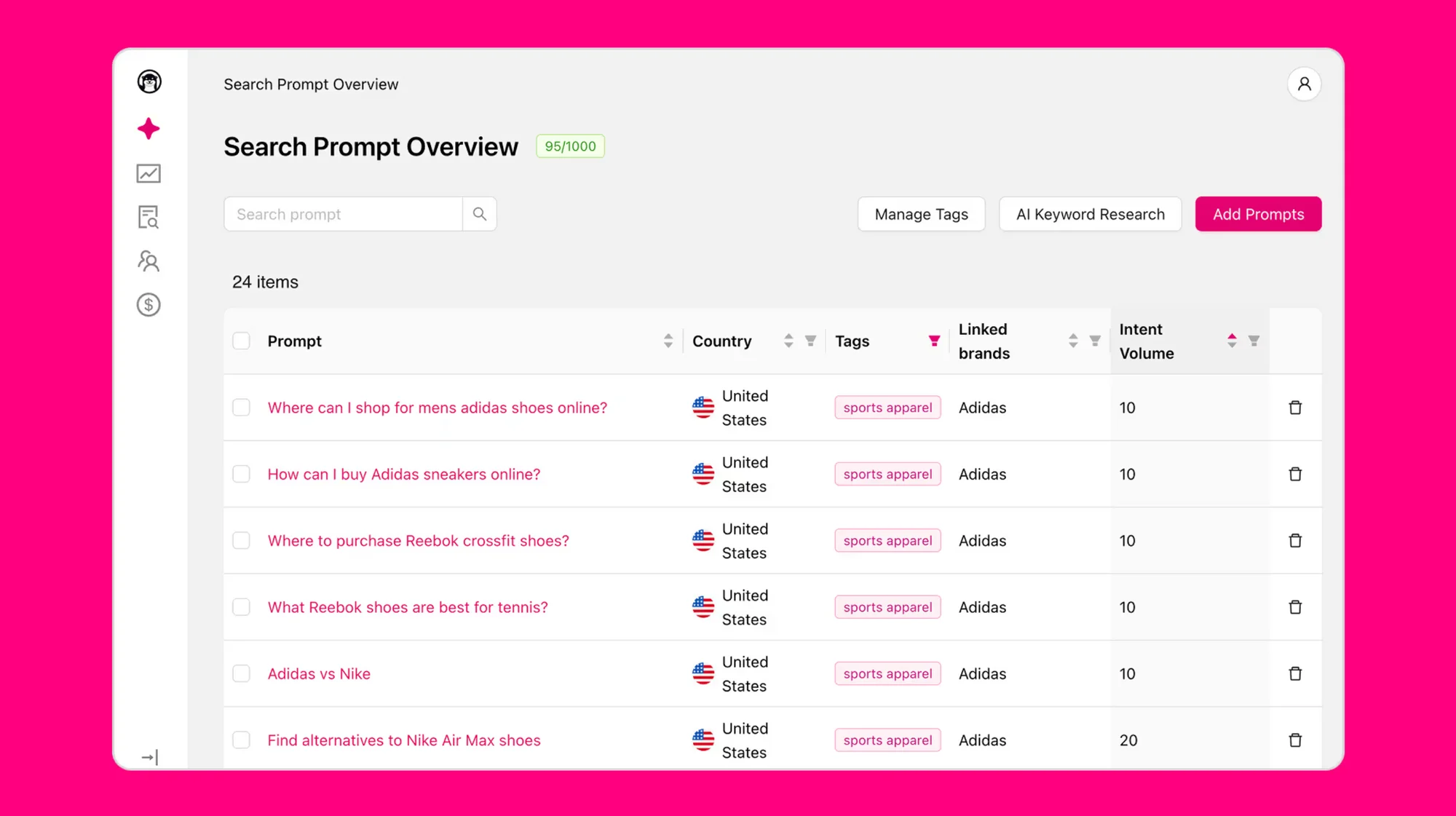
For scaling your multilingual, GEO-optimized content, use a localization platform like Localazy. It helps you manage translations across languages and channels, allowing you to publish consistently without getting overwhelmed with manual workflows.
With the right tools in place, you’ll be able to get a clear overview of what’s working for your brand and scale where it matters most.
🎙️ To what extent does it make sense to use LLMs in your translation process, and can they replace translators entirely? For more on this topic, listen to Bridging the Gap, S01, EP02
👀 Case studies: How more languages can boost your presence 🔗
Back Market 🔗
One good example of brands that succeeded in the quest for AI visibility while prioritizing multilingual content is Back Market. This marketplace switched to a more conversational tone, a style that resonates better with AI models than dry product specifications. Add to it the fact that their website is available in 15+ languages, and it’s no wonder that all these efforts are paying off: the brand reported a 470x increase in traffic from AI models year-over-year.
Expedia 🔗
Expedia, another global and multilingual player, is actively optimizing for generative search while enhancing the user experience through AI agents. The company reports increased booking rates and user satisfaction. According to Barron’s, which cites data from Similarweb, Expedia received roughly 88,000 referrals from AI search engines like ChatGPT and Perplexity in May 2025, which is a notable figure even if traditional search still dominates with 34 million referrals.
Reddit 🔗
Reddit has also focused on improving brand reach with multilingual content and effective GEO. It allows Google and AI models to index millions of user-generated posts, many of which are auto-translated, to ensure better visibility of fresh and relevant content across platforms and languages. While U.S. traffic remains strong for Reddit, there has been significant growth from French or German users. For both languages, Reddit has implemented real-time translation features to boost content visibility.

🔑 Visibility that connects and converts 🔗
Generative search has changed how people discover brands and how brands need to show up. Strategies based on optimizing for keywords or implementing multilingual SEO best practices are no longer enough. Visibility in the era of AI is a more complex game, where relevance, formatting, trust, authority, and natural language play a defining role.
By combining GEO with multilingual localization, you can create the conditions for real magic to happen and earn your brand prominent mentions in AI-generated answers. Not just once, but again and again. Across markets, languages, and platforms. And with a platform like Localazy, scaling your multilingual content strategy becomes not only possible, but also practical.