When I first moved to the United States from Korea as a middle schooler, Korea was not a very well-known country. People thought kimbap was basically sushi, or they didn’t really understand the charm of Korean culture. But starting in the 2010s, Korean culture began making its introduction to the world — from Gangnam Style and BTS, to Parasite, Squid Game, and more. Thanks to these cultural products, Korean consumer goods also started gaining global attention, from skincare to food, fashion, and beyond.
In addition, Korea has attracted significant attention from global companies, especially online services. The country has a population of 51 million, with 99% of it using smartphones, according to Gallup Korea. Another study by the Korean Press Foundation reports that 28.5% of children begin using smartphones at age five or older. This alone shows how early Koreans are exposed to online services, making the country a highly digital-native society. Many of my foreign friends often comment on how fast our internet is; perhaps the smartphone penetration and early exposure explain why.
However, despite the beauty of Korean culture and the country’s active technological environment, entering the market comes with major challenges. Korea has been a largely homogeneous society for a long time, and despite the number of foreigners hitting an all time high, Korean society is still learning to accept diversity as part of everyday life.

After helping dozens of global web and SaaS companies enter the Korean market, I’ve come to realize that most companies treat translation and localization as the same thing in the Korean market. But it’s not because of a lack of respect for their users: it is due to limited market knowledge, lack of resources, or an unclear localization strategy.
So what should you do to avoid turning potential fans into enemies?
🇰🇷 A brief note about the Korean language 🔗
Before diving into the localization tips, let me quickly summarize some basics about the Korean language.
Modern Korean originated in the 15th century, when King Sejong created Hunminjeongeum, a scientific writing system designed to increase literacy among common people. Over time, this system evolved into Hangul, the script used in Korea today.
Korean is the official language of both North and South Korea, but the two versions differ, especially in vocabulary. South Korean Korean (Hanguk-o) frequently uses English loanwords, while North Korean Korean (Chosŏn-o) replaces them with purely Korean alternatives. A simple example is 🍦 ice cream: 아이스크림 in South Korea vs. 얼음보숭이 in North Korea. It's also important to note that, in South Korea, there are several regional dialects, but the Seoul (Gyeonggi) dialect is the standard for business and formal communication.
The most common type of Korean used for commercial relations with the South is Hanguk-o, specifically the Gyenonggi dialect from Seoul
Another key concept is Konglish, or Koreanized English (some examples of its use here). These are English-like words used only in Korea, often seen in business settings, especially in job titles such as 프로젝트 매니저 (project manager) or 소프트웨어 엔지니어 (software engineer). While familiar to Koreans, these terms may not translate directly back into English, which can lead to confusion if not handled carefully.

Korean is culturally rich but layered with dialects, loanwords, and honorifics. This complexity is exactly why localization (not just translation) is essential for foreign companies entering Korea. Once you understand the patterns behind how Korean adapts foreign words and expresses hierarchy and context, creating a polished, natural local experience becomes much easier.
Now, let’s move on to five common localization mistakes foreign companies make when entering Korea.
💬 The 5 Korean localization mistakes I see the most 🔗
1. Leaving English text unlocalized 🔗
In Korea, using English is just not enough. It is important to remember that English is not an official language in the country, so it is very dangerous to assume that every Korean user will fully understand it. In addition, Korean users tend to be highly influenced by early feedback and reviews. If your product is entirely in English, chances are you will not only experience a high churn rate but also receive a significant amount of negative feedback. And once your first few reviews are negative, turning those detractors into fans becomes extremely difficult.
I've experienced this myself. The CEO of a Korean reward app once called me at 8 p.m. because they got too many complaints that their products were not fully localized. Despite having translated most of the basic information, we had left some sections unlocalized, including the original game title. This was not acceptable to the client: they communicated that they would end the contract if the problem was not fixed within that day. As a result, I ended up staying up until 3 a.m. to correct every issue. 📝
In my experience, companies with properly localized services generate up to 10x more revenue in Korea than those that do not offer them
Take another example. One of the companies I worked for managed several Korean advertising campaigns, and I remember one specific product based on a famous American animation IP that performed exceptionally poorly. When I looked into the product, I realized the problem immediately — the texts were not localized at all. The fame of IP could not stop users from leaving, and this particular product had a 90% churn rate within two weeks.
This 90% churn rate and termination of contract could be your data if you don't take Korean localization best practices into account, or if your localization is not done at all (or done poorly).
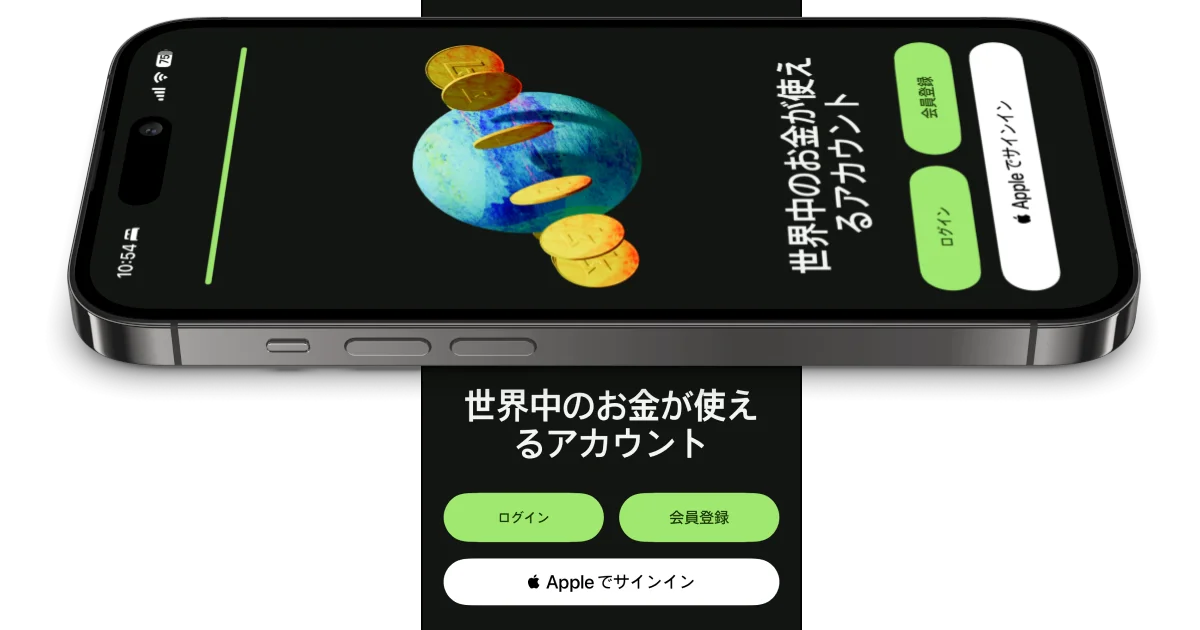
While this is less common, some companies offer Korean services with Japanese text. 🤯 Above these lines you can see an example from the fintech app Wise. This screenshot, taken by a Korean user based in Korea, shows that the interface appears in Japanese. It is crucial to remember that Japanese and Korean are very different languages. Obviously, if the app that is targeted toward Koreans is in Japanese, Korean users will leave as soon as they open it.
These shows how poor localization can directly impact your reputation in the market. And in my experience, companies with properly localized services generate up to 10x more revenue than those that do not.
2. Wrong or inconsistent honorifics 🔗
Honorifics are one of the most common issues I see when English content is localized into Korean. Because English has no grammatical markers for honorifics, the same sentence, like “How are you?”, can be used both for a close friend or a senior manager. But in Korean, this distinction is essential. The tone you use for a friend must not be used for your boss, and being too polite can be just as unnatural as being too casual.
The same applies to user messaging. Unless you’re targeting teenagers or trying to give a next-door friend vibe, it is safer to go with a formal version. Let’s say that you are a UX copywriter for an e-commerce app targeted toward women in their 30s. Generally, if you’re dealing with adults it is always best to choose the formal register. For example, if you have to translate: "Want to get this later? Save it on your list!", this would be the wrong way to do it:
❌ Want to get this later? - 나중에 사고 싶어? (casual)
Save it on your list! - 리스트에 이것을 저장하세요! (formal)
Why? Because while this targets adults, it uses an informal tone that is not appropriate in the context. How can we make this sound more natural?
✅ Want to get this later? - 나중에 구매를 원하시나요? (formal)
Save it on your list! - 리스트에 저장하세요! (formal)
In this case, the formality is consistent - which makes the whole UX flow more naturally.
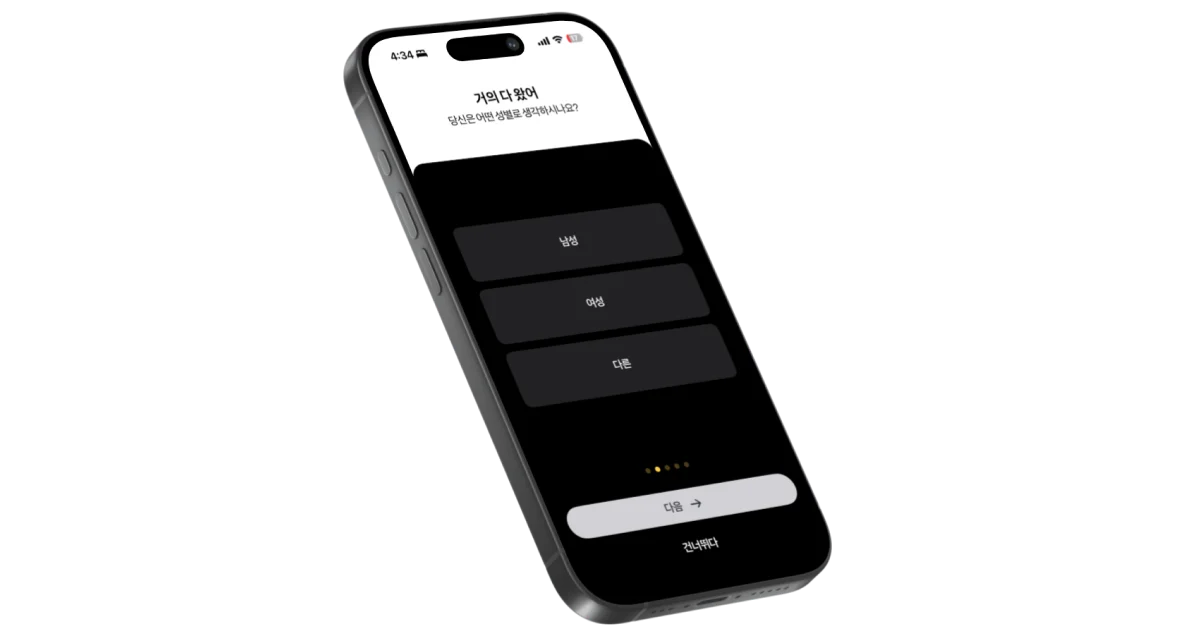
Now let’s look at this real world example from a reward app’s sign-up page:
❌ 거의 다왔어 - Almost there! (casual)
당신은 어떤 성별로 생각하시나요? - What do you think your gender is? (formal)
Just like in the example above, in this instance honorific levels don’t match. This inconsistency immediately signals to Korean users that the product wasn’t created by a Korean team, and it creates discomfort at the earliest stage of the UX flow.
How could we fix this?
✅ 거의 끝났어요 - Almost there! (formal)
당신의 성별은 무엇인가요? - What do you think your gender is? (formal)
The good news is that honorifics in Korean UI writing have a formula. In most app contexts, you can safely follow these patterns:
- Commands: ~하세요
- Questions: ~할까요?, ~하시겠습니까?, ~한가요?
- Statements: ~합니다, ~해요
- CTA buttons: Verb-noun forms like 시작, 가입, 홈으로 이동, etc.
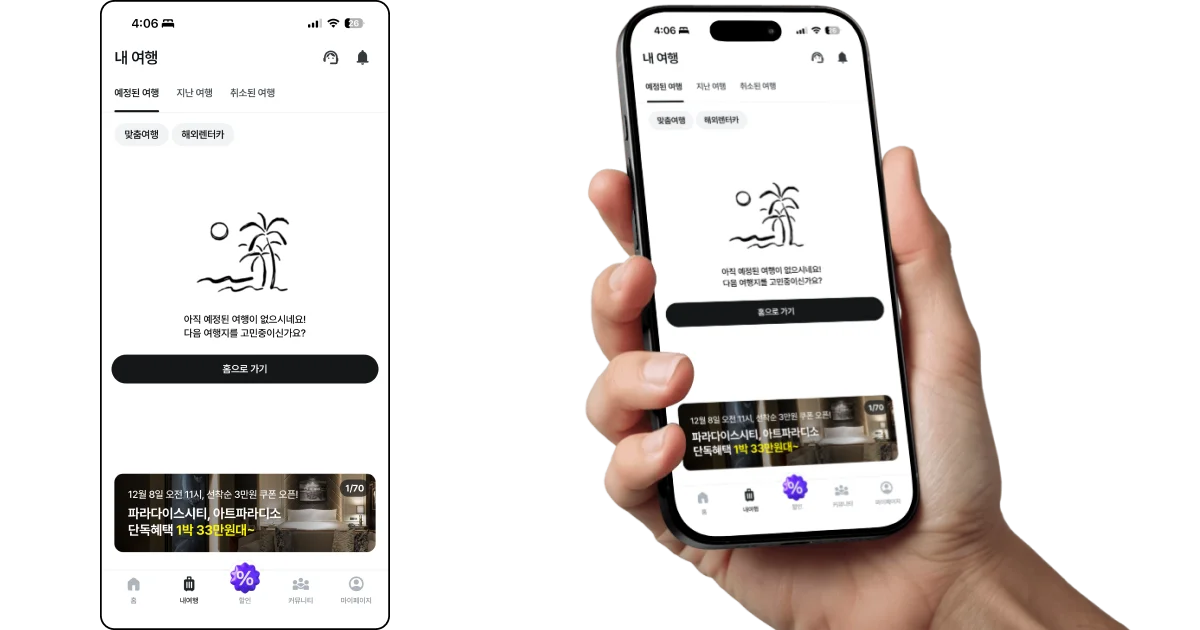
Here’s a well-done example from MyRealTrip, a Korean travel app similar to Agoda or Booking.com. The microcopy below the palm trees ends with -요, creating a tone that is polite yet friendly, perfect for consumer apps. Meanwhile, the CTA avoids a literal “go home” translation (집으로 가세요) and instead uses noun forms like 홈으로 이동 ("move to home"), which sound much more natural in Korean UI design.
3. Awkwardly translated subjects (especially "you") 🔗
Subjects are one of the most mishandled parts in Korean localization, partly because of the level of importance a subject holds in a sentence. In English, you need a subject to form a sentence. In Korean, however, the subject is often implied. One of the most common mistakes I see is translating you as 귀하. While politeness matters, being too polite often creates awkwardness. 귀하 is used only in official documents, such as terms and conditions. Apps, however, are not meant to sound official; they’re meant to interact naturally with users.
So how should you approach translating you into Korean without sounding awkward? Two common options:
- Skip the subject entirely.
- Replace “you” with a user-appropriate role (ex. 고객님, 멤버님, 이용자님).
Let's take the example below, which is another app sign-up page:
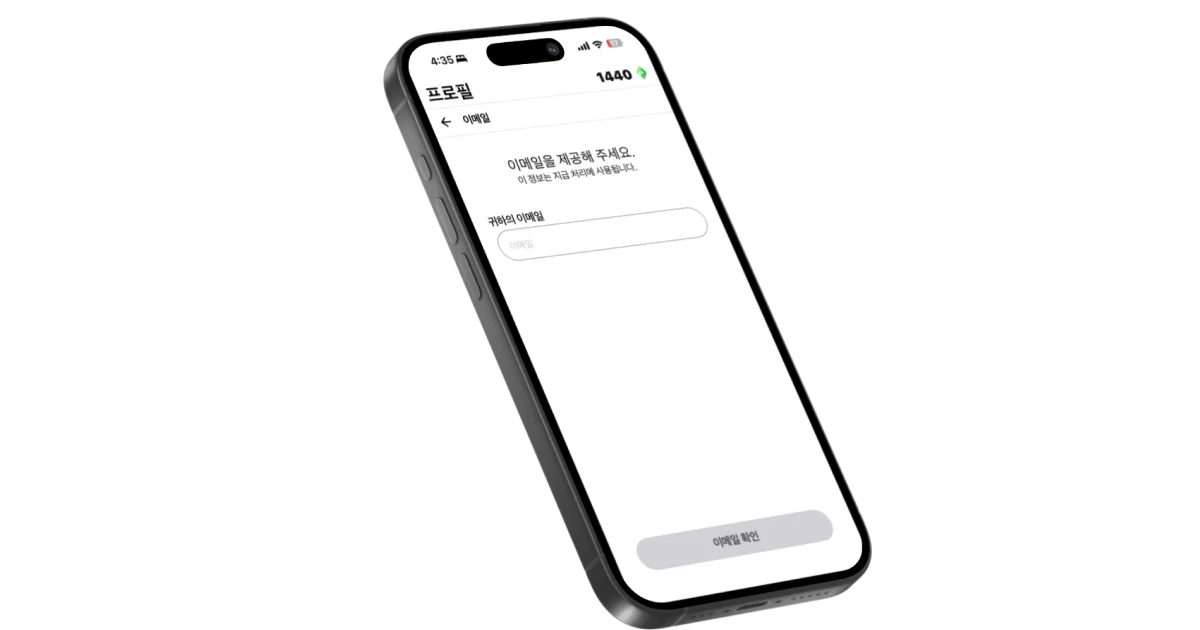
Do you see the text “귀하의 이메일”? This is meant to be “your e-mail”. In Korean, a more natural way to phrase this would simply be “이메일”, which translates to “e-mail”. It is already clear that the app is asking for the user’s e-mail address, so explicitly saying “your” is unnecessary.
The next example shows a better approach from LinkedIn. Here, “you” is translated as 회원님, meaning “member,” which fits the platform and sounds natural:
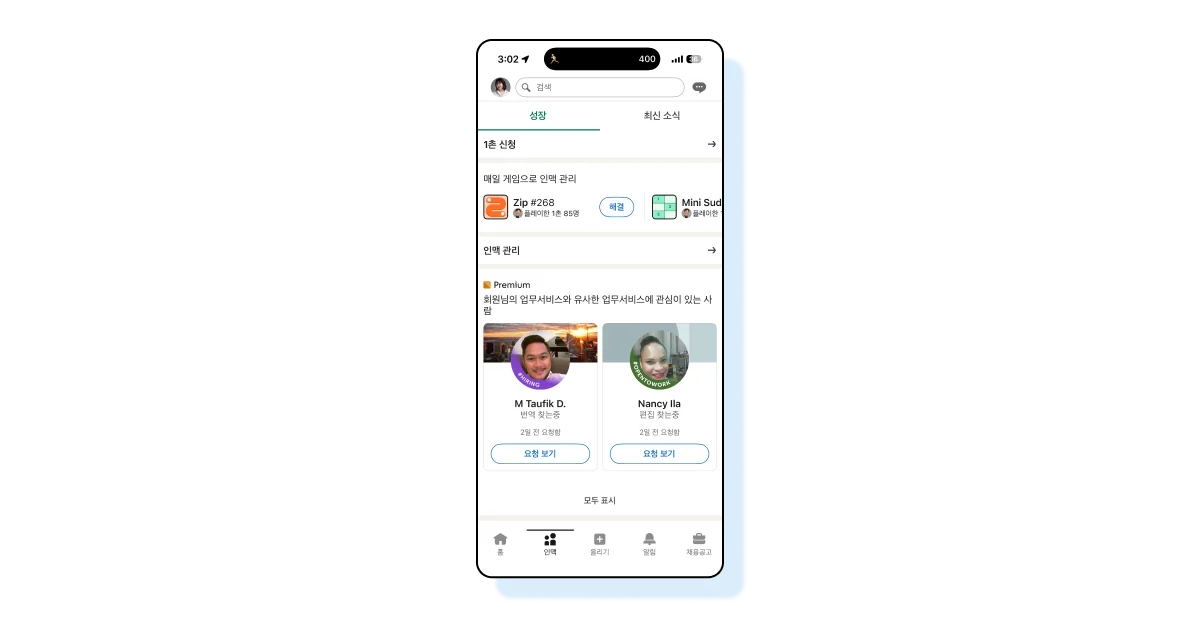
At the end of the day, translating “you” into Korean involves understanding how Koreans communicate, even if you have accurate grammar. If you get this small nuance right, your entire product suddenly feels much more welcoming and familiar to Korean users.
4. Incorrect terminology / lack of transcreation 🔗
This is another reason why I strongly discourage companies from solely relying on AI for translation. While many terms can be directly translated, many others cannot. In Korean, companies often use abbreviations of English words (e.g., CTA), transliterate the English term into Korean (e.g., 캐주얼 게임 for “casual game”), or create entirely new terminology for branding purposes. Tying this back to what I mentioned earlier, what you find in a dictionary is often not what is commonly used in real-life contexts. And AI cannot reliably catch these nuances. This becomes even more complicated when the content is an internal document, where only an expert can judge which terminology is appropriate.
Korean terms found in dictionaries are often different from what's used in real-life contexts. You cannot trust AI to catch this: the best solution is to consult a native expert or work with a linguist
Let’s assume you are translating a sentence for an HR company and encounter the term 🧑🏻💼 “career coach”. Many times, I see this translated as “경력 코치”. Is it technically wrong? No. But is it widely used? Also no.
Then, how can you make sure your internal terminology is correctly localized? Unfortunately, there is no one-size-fits-all answer because each company has different branding, tone, and market context. In these cases, it’s essential to work with a linguist or native expert who has strong industry knowledge and can guide you toward consistent, natural terminology.
The stakes here go beyond individual word choices. In May 2026, Starbucks Korea's marketing team used generative AI to brainstorm a merchandise campaign, and no native cultural reviewer caught that the campaign name and slogans echoed language tied to the 1980 Gwangju massacre, triggering a nationwide boycott, criminal complaints, and a public apology from the parent company's chairman. It's a stark reminder that AI can generate fluent content without any sense of what that language means to the people reading it.

5. Abuse of puntuaction marks 🔗
Korean writing uses punctuation just like English, but not all punctuation marks appear with the same frequency. Two marks that are relatively uncommon (especially in UX or app environments) are exclamation marks and semicolons. Semicolons rarely appear in Korean interfaces, so let’s focus on exclamation marks.
I generally recommend that non-native Korean writers avoid overusing exclamation marks. They are not “incorrect”, but they must be used sparingly to avoid sounding overly emotional, unnatural, or foreign. Korean text is highly context-sensitive, and when an exclamation mark is used in the wrong situation, users can immediately sense that the UX was not designed with the Korean market in mind.
Korean companies do not use exclamation marks nearly as often as Western companies. Abusing them in your product's UX can sound unnatural
Below is an example from the Just Dance app:

Take a look at the two texts with exclamation marks:
❌ 위대한 댄스기빙! - Great Dance-giving!
추수감사절과 블랙 프라이데이를 즐겨봐요! - Enjoy Thanksgiving and Black Friday!
In English, this sounds perfectly fine. In Korean, however, it feels awkward. Why?
First, Korean companies do not use exclamation marks nearly as often as Western companies. If I had to quantify it, the ratio of sentences with exclamation marks versus those without is roughly 1:9. Exclamation marks may appear at the end of a sentence, but even then, they are not common. Given this, the “Great Dance-giving!” line would have been more natural without the exclamation mark:
✅ 위대한 댄스기빙 - Great Dance-giving
추수감사절과 블랙 프라이데이를 즐겨봐요! - Enjoy Thanksgiving and Black Friday!
Another example comes from the global fintech app Payoneer. Take a look at the CTA “시작합니다!”, which corresponds to “Start!” or “Get Started!":
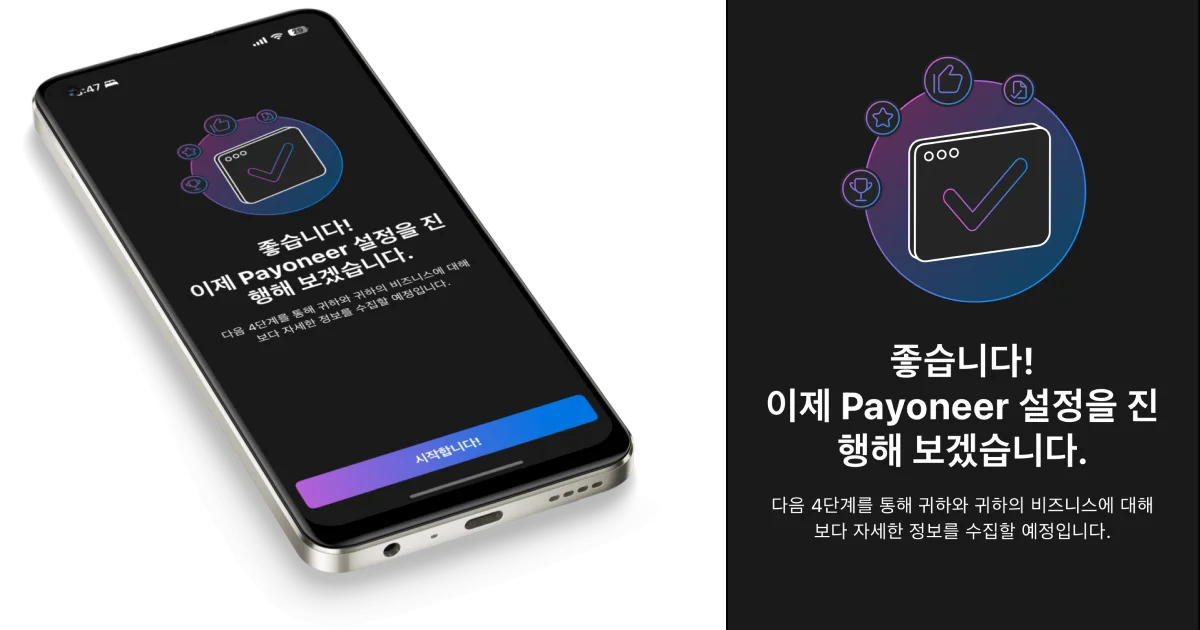
Again, the translation is not incorrect. But, as mentioned earlier, CTA buttons in Korean typically end with noun forms, and exclamation marks are generally avoided. In this case, “시작하기”, which means “Start”, would sound much more natural without the exclamation mark.
The use of punctuation in Korean is highly nuanced, as shown in these examples. This is why, again, it is crucial to consult with Korean linguists who can provide guidance on when certain options should or shouldn't be used.

🫰Nail your messaging to succeed in Korea 🔗
Korean is indeed a very beautiful and culturally rich language, with so many options to express the same concept. At the same time, it is also a highly nuanced tongue, which means that some might find it daunting. However, Korea is one of the most digitally native countries in the world. If you get the translation right, you are already one step closer to succeeding there.
This article mainly discussed some dont's for Korean localization of apps and websites, but in an upcoming article, we'll take a look at some do’s for Korean SaaS localization and discuss the importance of UX in your strategy, including the use of Naver and other popular digital platforms.
For now, if you want to get your messaging right, I highly suggest taking a look at Localazy’s professional translation services. You can directly order help from a native Korean linguist within their UI, and the rest of the localization workflow can be handled all within the platform, which I find super convenient.