Accessibility in localization isn't a topic most people in the industry talk about. There's some academic work on it, but the conversation is small and rarely reaches the people doing the actual work.
A few months ago, I had a conversation with Jakub, the CMO of Localazy. We were talking about how languages evolve, the way scripts have come and gone, and how meaning can shift in different contexts. If you've been following Localazy's content, you'll know they've been doing serious work on languages for a while now, especially on the research side, so the conversation drifted naturally. Somewhere in there, we got to a question neither of us could answer: how is the localization industry dealing with accessibility today? So we decided to ask the people doing the work directly.
I'd already noticed that getting decision-makers to talk about this topic was no small feat. Most weren’t sure what accessibility measures they had in place (if any), and the practices varied a lot depending on the industry and the scale of their localization projects. Since it was difficult to get rigorous answers through regular conversations alone, we turned our quest into a proper research project and designed a survey.
Getting decision-makers to talk about accessibility is no small feat. Practices vary a lot depending on the industry and the scale of projects. And when we finally got their responses, we detected a contradiction
The topic was already difficult to start with, and the first version of our questionnaire failed. It was too long: the drop-off rate was high, and our initial outreach (batched emails to customers and an in-product banner) didn't generate enough responses. Marta, Localazy’s Head of Content, and I sat down and reworked the survey into something that people could complete in three to five minutes. We also split it into two: one for the localization professionals doing the day-to-day work, and one for the decision-makers deciding budgets, project scope, and briefings. The questions were also reviewed by Dr. Silvia Rodríguez Vázquez, an Associate Professor at UOC who has been researching accessibility in localization for over a decade.
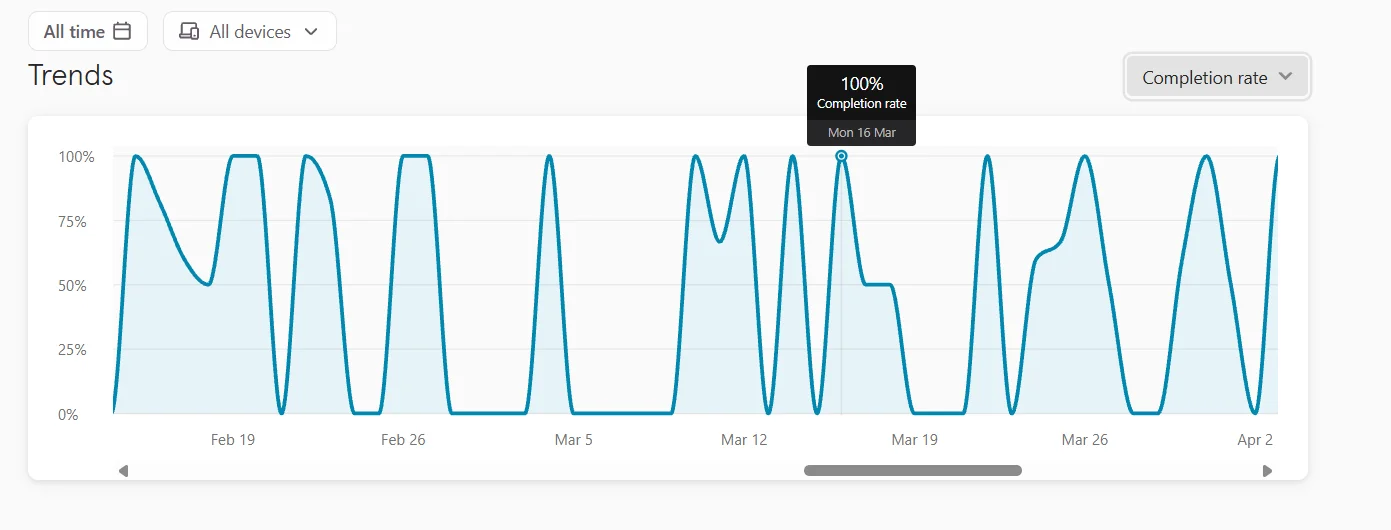
From there, and with the help of my colleague Marine, I started reaching out directly to localization professionals across the EU on LinkedIn. Lo and behold: the completion rate for that survey jumped to 78%. As of now, 204 professionals have responded, and many have taken the time to provide detailed answers to the open-ended questions.
🤷 The accessibility contradiction 🔗
The data revealed something interesting... a contradiction. Most of the professionals we surveyed said accessibility is important or essential for the future of their work. But then, when we asked who, in a typical project, is actually responsible for ensuring that the final translated product is actually accessible, the most common answer was: no one.
They couldn't point to anyone in their teams. Not QA, not the product team, not a dedicated accessibility specialist... In many projects, accessibility isn't simply a formal part of the localization process.
One respondent described it like this:
"Developers and localizers do not work together; localizers are told to just translate keys with little or no control of the actual context"
Another respondent framed the issue from a different perspective:
"The biggest obstacle is that accessibility is typically handled as a final step instead of being part of the initial design process."
Outside the survey itself, the pattern repeated in my conversations with professionals. Many mentioned how glad they were that someone was asking about this topic at all. Some continued the conversation well beyond the survey and shared experiences from their own projects. That, in itself, says that the the gap is not only in the processes or the data, but also in how rarely the profession is invited to reflect on accessibility in a structured way.
We observed something similar when respondents were asked about WCAG, the global standard for accessible content. Most were either unfamiliar with the guidelines or said they had little connection to their day-to-day localization work. Many also reported never having received formal training on how accessibility intersects with localization. Among those who had, several mentioned that the training took place years ago.
The situation didn't change much when it came to decision makers. Their answers to the second survey reflected the same block point. Most said their organizations don't currently follow accessibility standards consistently, with budget and time constraints emerging as the main barriers.
📣 Coming up: Full report on accessibility in localization 🔗
Global web accessibility is regressing: according to WebAIM's latest analysis of the top 1 million websites, 95,9% of homepages currently have WCAG 2 failures. A whopping 56.1 errors per page act as barriers for people with disabilities and impact their overall user experience.
We want to find out what's blocking implementation at the industry level, and this is just the start. The rest of our data is going into a detailed whitepaper and a more in-depth journal article led by Dr. Rodríguez that will be published later this year. The report will cover what the gap looks like in training, the tools used and project scoping, and the practices already in place within the industry.
"One of the clearest conclusions emerging from our research is that most professionals see accessibility as important, but very few organizations have integrated it into their actual localization workflows. Awareness is there; implementation is still catching up.”
- Sílvia Rodríguez Vázquez, Associate Professor at UOC and Web accessibility researcher
If you are a decision-maker in the industry and want to participate in the final report, feel free to reach out to me via LinkedIn. You can also check out some earlier pieces about the topic, including this article, our podcast episode about the topic, and our accessibility cheatsheet here.
👀 Keep an eye out for the report later this year!