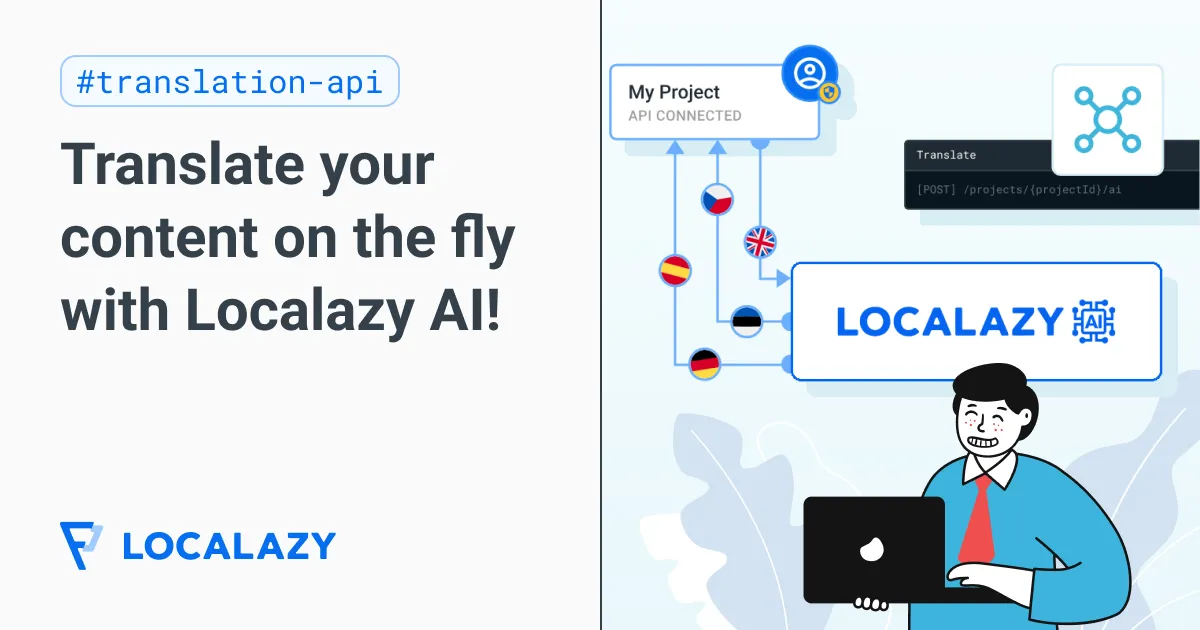
Translation API
A service that allows applications to send text for translation and receive translated output programmatically in real time.
Instead of exporting content and translating it manually, software can send text to the API and receive translations instantly as part of the user experience. Most translation APIs support standard protocols such as REST and accept structured requests with source text, target language, and optional context. Many APIs also support batch requests, plural forms, and formatting rules, allowing developers to translate multiple strings in a single call.
Translation APIs can be powered by machine translation engines, Large Language Models (LLMs), or hybrid workflows that combine them with human review processes. Some APIs also integrate glossaries and style guides to improve translation consistency.
In localization, translation APIs are used to translate dynamic content, automate localization pipelines, and deliver multilingual experiences in an instant and usually for real-time translations.
🔌 Key points about translation APIs:
- They allow applications to translate content on demand through simple HTTP requests.
- Most APIs support real-time translation, batch processing, and language detection.
- They can handle structured content such as plural forms, variables, and localization keys.
- Many APIs integrate glossaries and context to improve translation accuracy.
- They are commonly used in apps, websites, CMS systems, and developer pipelines.
Unlike traditional localization workflows that rely on manual export and import, translation APIs enable continuous and automated translation directly inside products.
🧪 Examples of translation APIs in practice:
- A multilingual chat app uses a translation API to translate messages between users in real time.
- An ecommerce platform sends product descriptions through an API to instantly publish listings in multiple languages.
- A SaaS product uses an API to translate UI text dynamically when users switch languages.
Localazy provides a Translation API that allows developers to send multiple strings, include context, and receive translations using AI and fallback engines in a single request. Visit our documentation to start implementing it.